Plants vs. Zombies Makes Every Patch of Lawn a Strategy Puzzle

Plants vs. Zombies™
The first zombie shuffles toward your house while the sun meter sits nearly empty. You have time to plant one defender, perhaps two, and the wrong choice can leave a lane wide open. That small, readable crisis is the enduring trick of Plants vs. Zombies™: it makes strategy feel immediate, funny, and just tense enough to keep you reaching for the next level. This is not a sprawling war game or a deck of complicated systems. It is a tidy lawn-defense puzzle whose strongest resource is your attention.
A garden that becomes a battlefield
Why it deserves attention
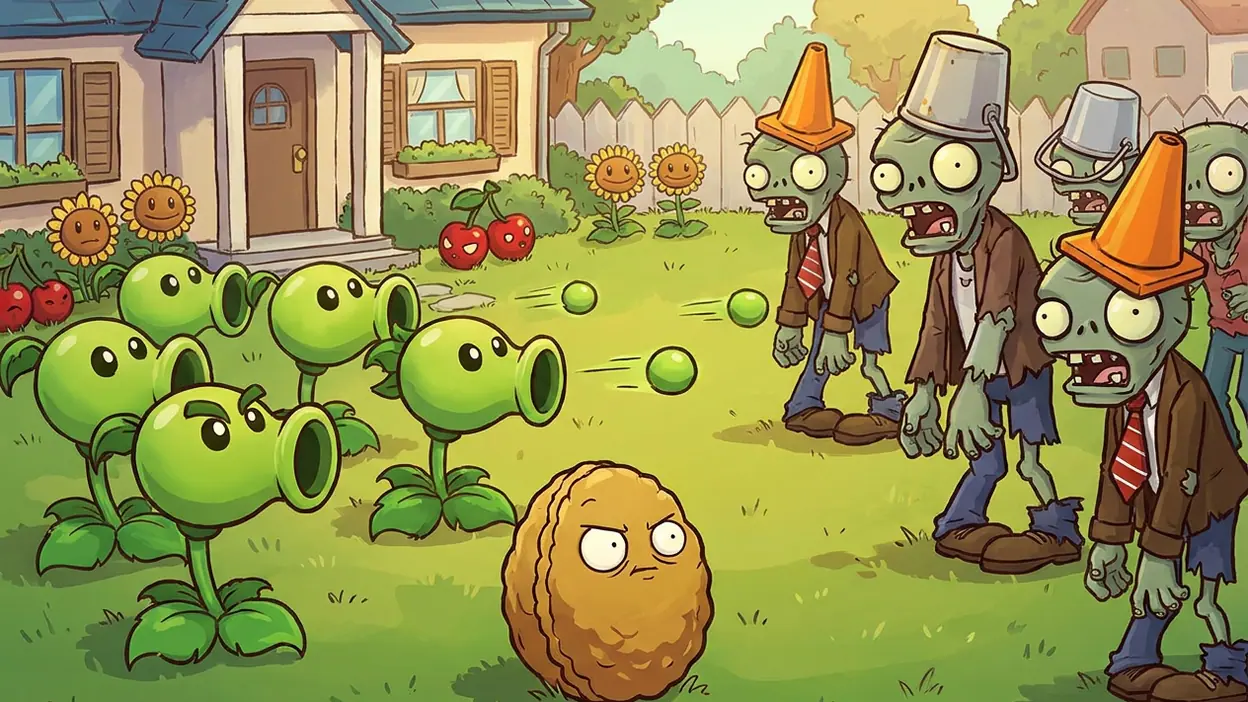
Many strategy games ask players to learn a whole economy before the stakes become clear. Here, the stakes are a line of zombies approaching your front door, and the rules arrive in manageable pieces. Sunflowers generate the sun you spend on plants; Peashooters fire down their lanes; Wall-nuts buy time by soaking up attacks. Each plant has a legible job, and each zombie gives that job a new complication.

Plants vs. Zombies™
ELECTRONIC ARTS · 3.7 · Free · Android, iOS


That clarity does not make the game shallow. It makes its decisions easy to read and satisfying to improve. You can see why a defense failed: a lane lacked damage, a slow defender came too late, or you spent precious sun on the wrong answer. The game rewards planning without making every mistake feel like a lecture. Its best levels are small tactical problems with room for a personal solution.
The opening hook
The opening is a gentle trap. A few ordinary zombies drift across a bright suburban lawn, and the first plants make short work of them. Then the game adds another lane, another enemy, or a new plant with a useful wrinkle. The lawn begins to look less like a blank patch of grass and more like a board you must read from left to right.
Sun is the first source of pressure. You need enough production to build a proper defense, but every Sunflower planted early is a defender you are not placing now. Wait too long and the zombies gain ground; spend too freely and you may lack the resources for the next wave. The opening teaches that trade-off through play rather than a dense tutorial, then keeps finding fresh ways to make it matter.
How the core loop feels
Each level settles into a pleasing rhythm: collect falling sun, plant a compact defense, watch the next wave reveal its weak point, then adjust before the lawn is overrun. The action unfolds in lanes, so the field stays readable even when several enemies arrive together. You are rarely clicking without a reason. A plant placement has a clear cost, a clear purpose, and a result you can watch almost immediately.
That rhythm has a lovely tension curve. At the start, you are building an economy. In the middle, you are patching gaps and preparing counters. Near the end, the screen fills with shuffling bodies, projectiles, and the satisfying clatter of a defense holding. A Peashooter line may carry the day, or it may take a Tall-nut, a Snow Pea, and a well-timed explosive to stop a bad lane from collapsing.
Every plant is a decision with a visible consequence. That is the core pleasure, and it keeps the game from feeling like a passive tower-defense display. You are not only watching a plan work; you are deciding when to spend, where to reinforce, and which threat cannot be allowed through.
Progression and rewards
Progression is built around new tools rather than an endless ladder of numbers. As the campaign advances, the game introduces plants and zombies that alter your priorities. A defender that felt dependable on the front lawn may be a poor fit for a level with a different layout or a new enemy trick. The campaign keeps asking you to rethink the arrangement instead of relying on one overpowered formation.
New plants are the best reward because they expand your vocabulary. A Snow Pea slows a target while dealing damage, while defensive plants can buy the seconds needed for your shooters to finish the job. When a level ends, the reward is often less about a pile of currency than the feeling that you now understand a new piece of the puzzle. That makes progress feel earned and practical.
The game also branches beyond its standard daytime lawn. Changes in setting and conditions alter how you approach a level, and the collection of side activities gives the campaign a welcome change of pace. The structure is not a modern service-game treadmill; it is a sequence of challenges that mostly respects your time. You can make a little progress in a short session and still feel the campaign moving forward.
Why sessions are hard to stop
Levels are short enough to invite a quick try, but they end with just enough unfinished business to make another attempt tempting. Perhaps you want to test a different plant lineup, clean up a messy finish, or see what the next unlock does. The game rarely needs a dramatic cliffhanger. It gives you a compact problem, a clear result, and the promise of a slightly different one just ahead.
There is also a strong sense of control in the repetition. Losing a level usually points toward a fix you can imagine: build income sooner, protect a vulnerable lane, or save a special plant for the enemy that demands it. That makes retrying feel like experimentation rather than punishment. The short rounds let you test a better plan before the memory of the mistake has faded.
Its humor helps the loop stay light. Zombies are ridiculous without becoming harmless, and the plants have enough personality to make a solid defense feel like a tiny victory parade. The tone takes the edge off failure, while the approaching wave keeps each placement meaningful. It is a smart balance: the game can make you laugh at a zombie and still make you scramble to stop it.
Style and identity
The visual identity is unmistakable: a cheerful suburban lawn, clean lane-based staging, expressive plants, and zombies that look more goofy than gruesome. The art communicates function as well as mood. You can tell a sturdy blocker from a fast attacker at a glance, and the silhouettes remain readable when the field grows busy. The sound design adds character to the action without drowning out the simple decisions.
That clarity is a form of craft. The game does not need realistic lighting or elaborate camera moves to make a wave feel dramatic; it lets the lawn itself become the stage. A line of Peashooters, a stubborn Wall-nut, and a crowd pressing in from the right are enough. The world feels welcoming, but its rules are exact.
Who it is perfect for
This is an excellent fit for players who enjoy tactical choices but do not want a long preparation phase. It suits short breaks, relaxed evenings, and anyone who likes discovering a counter to a new enemy. Beginners can understand the basics quickly, while more experienced players can still enjoy optimizing their plant choices and timing.
It is also a good recommendation for people who bounce off strategy games that bury the fun under upgrade menus, timers, or a constant demand to check back. Plants vs. Zombies™ gives you a focused board and lets you play. Its difficulty rises through new situations, not through a requirement to spend hours grinding before the next meaningful decision.
Where it frustrates
The same straightforward structure can become repetitive if you want a deep competitive ladder or a long-term system built around ranked play. The campaign asks you to master its own patterns, but it does not offer the broad social stakes found in games such as Clash Royale or Clash of Clans. Players who thrive on live opponents, alliance activity, or constant account development may find its self-contained levels a little quiet.
Some stages can also punish a poor opening before you have much room to recover. If your first few placements leave the economy behind, the pressure can snowball quickly. That is useful when it teaches a lesson, but less satisfying when a level’s surprise feels like a demand to restart and memorize the right response. The game is fair more often than not, yet its older design can occasionally expect trial and error rather than offering a generous safety net.
On mobile, touch controls suit the simple board well, though small targets and busy moments can make careful placement less comfortable on a compact screen. The clean presentation helps, but this is still a game where a misplaced plant can matter. It is worth playing with enough screen space to see the whole lawn clearly.
How it compares with genre favorites
Clash Royale turns strategy into rapid player-versus-player clashes, and Lords Mobile: Kingdom Wars and Last War: Survival Game build around larger progression systems and ongoing development. Plants vs. Zombies takes the opposite route. Its battles are self-contained, its economy is visible on the board, and its satisfaction comes from solving the level in front of you rather than maintaining a sprawling account.
That smaller scale is its advantage. There is no need to memorize a shifting competitive meta before a round can be fun. The game’s challenge lives in the relationship between a handful of plants and a wave with a particular weakness. If you want social rivalry and months of account-building, those alternatives have a different appeal. If you want strategy that becomes enjoyable within minutes and stays legible under pressure, this lawn remains a remarkably sharp design.
Why it is worth installing now
Mobile games often compete for attention with daily check-ins and layered reward tracks. This one earns another session by making the next level interesting. Its essential appeal is still immediate: a clear threat, a limited resource, a handful of tools, and the pleasure of watching a plan hold together. That kind of design travels well, whether you are returning after years away or discovering the game for the first time.
It is also easy to recommend because its identity is so complete. The plants, the zombies, the lawn, and the dry comic tone all serve the same simple idea. Nothing feels bolted on to keep you busy. You play because the next tactical puzzle sounds fun, and that is a stronger reason to install a strategy game than a stack of timed incentives.
Final verdict
Plants vs. Zombies™ remains an unusually inviting strategy game: funny on the surface, thoughtful in its decisions, and disciplined about keeping each round readable. Its best moments arrive when a seemingly calm lawn turns into a scramble and a carefully built defense stops the wave by a sliver. Repetition and a few unforgiving openings are real drawbacks, but they do not erase the precision of the core loop. Install it for a quick garden-defense diversion; stay because each level makes you believe the next arrangement might be even better.