My Talking Tom 2 Turns Tiny Routines Into a Lasting Habit

My Talking Tom 2: Pet Game
My Talking Tom 2: Pet Game makes a small promise and keeps it: look after a cat, make him laugh, and see what happens next. That simplicity is exactly why the game can travel so quickly through feeds and family chats. Its current appeal is not a reinvention of mobile gaming; it is a return to a kind of low-pressure play that is easy to understand at a glance. The more interesting question is whether Tom’s daily mischief can hold attention after the novelty has worn thin. My read is that the game has a sturdy habit loop, but its long-term pull depends on how much a player enjoys caring for a character rather than chasing a finish line.
Why Tom is back in the conversation
Virtual pets are unusually legible entertainment. There is no complicated premise to explain, no long tutorial to sit through, and no need to be an expert to enjoy a cat reacting to a tap. That makes Tom unusually well suited to short-form video, casual recommendations, and younger players discovering a character that older players may already recognize. The game can feel new to one person and comfortably familiar to another, an overlap that helps a trend spread across age groups.

My Talking Tom 2: Pet Game
Outfit7 Limited · 4.3 · Free · Android, iOS


There is also a broader appetite for games that ask less of players. A round of Candy Crush Saga frames its appeal around a puzzle and a clear target. Township gives its players a growing town to manage. Tom’s pitch is more immediate: he is there, he needs something, and he will respond. That direct relationship is easy to demonstrate in a clip and easy to revisit when a player has only a spare minute.
Still, a burst of attention should not be confused with a sudden redesign or a new competitive scene. The game’s momentum comes from a dependable format, a recognizable character, and the way its small comic beats fit social platforms. It is a resurfacing of an old kind of mobile pleasure, not a revolution in how phone games work.
The little reactions players remember
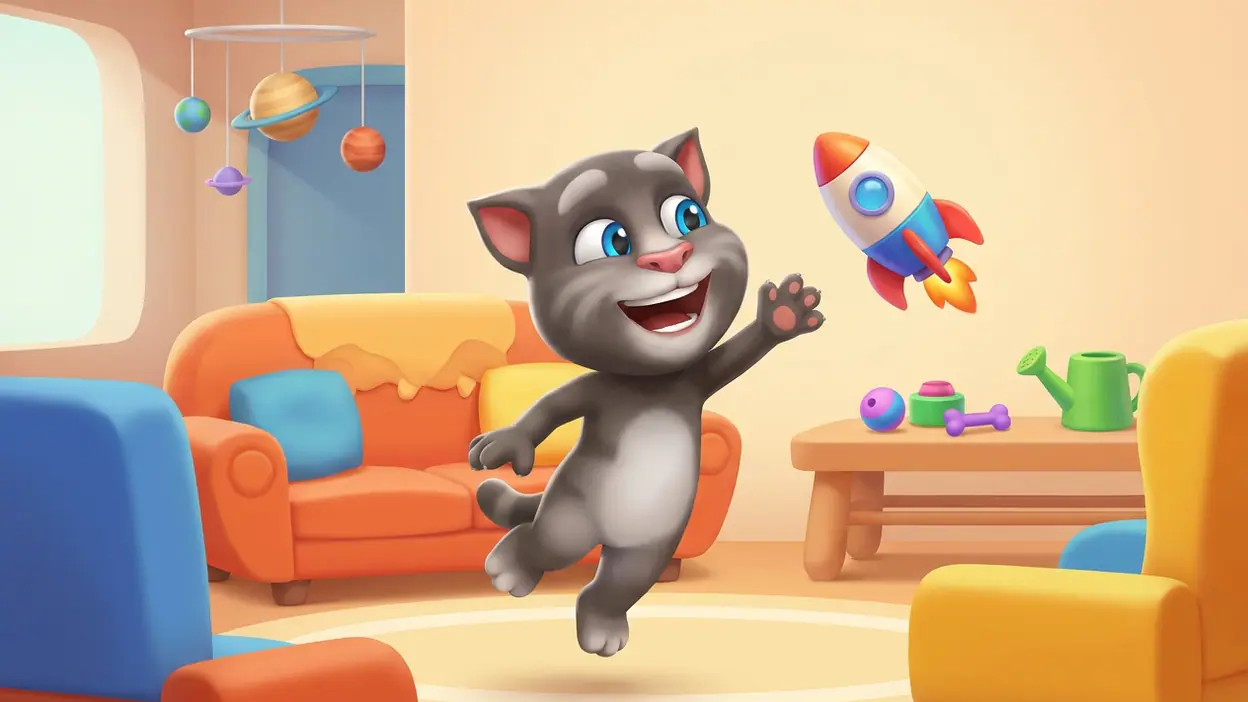
Tom is at his best when he feels responsive without becoming demanding. Tap him and he reacts; feed him and his mood shifts; let him play and the scene becomes a miniature performance. The pleasure is not merely collecting tasks and checking them off. It is watching a character turn a routine interaction into a gag. The game’s physical comedy gives even ordinary care actions a bit of personality.
That is a meaningful distinction from Pou, whose spare, almost blank character leaves more room for players to project their own feelings onto it. Tom arrives with stronger animation and a more expressive comic identity. The trade-off is that he can feel less like a pet the player invents and more like a performer the game supplies. For many, that is the point: the joke is ready to go, and there is little friction between opening the game and getting a reaction.
Care routines give those reactions a rhythm. Hunger, cleanliness, rest, and play create small reasons to return, while mini-games and collectible rewards add variety around the edges. This is not a high-stakes loop. There is no demanding strategic system to master, and that softness is part of its comfort. But if a player wants every action to unlock a meaningful new layer, the repeated cycle can start to feel like maintenance.
The game’s strongest emotional hook is also its simplest: Tom appears to notice what the player does. That illusion of response can make a brief session feel personal, especially for children. Yet the relationship has boundaries. The character’s needs are designed prompts, not a genuinely evolving bond, and the game can only vary its reactions so far before the pattern becomes familiar.
A routine built for quick returns
The retention design works through gentle incompleteness. There is usually one more need to meet, one more activity to try, or one more reward to collect. Instead of pushing players through a long campaign, the game places a few soft invitations in front of them and lets them choose. That makes it easy to leave after a short visit and equally easy to come back later.
This can be a better fit for casual play than a relentless progression ladder. Tom does not ask for a perfect streak or a complicated plan before the next session makes sense. The routine is visible and forgiving. At the same time, the structure leans on repetition: care, play, reward, return. Once the player understands the pattern, the question becomes whether Tom’s reactions and the range of activities keep that pattern lively.
Here the game is more charming than deep. Its mini-games break up the care cycle, but they do not turn the experience into a demanding skill test. Players seeking the clear mastery curve of a puzzle game may find little to pursue. Players who enjoy making small progress and checking in on a familiar character are more likely to settle into it.
Customization helps give returning sessions a visible payoff. Changing Tom’s appearance or collecting new items can make the pet feel more like the player’s own, even if the underlying routine remains recognizable. These rewards work best as personal decoration, not as a reason to grind endlessly. The game’s pace stays pleasant when players treat the extras as bonuses rather than a checklist they must complete.
Why the moments travel
Tom is naturally streamable because his reactions are readable even without context. A viewer can understand the setup in seconds: a familiar cat, a simple action, an exaggerated response. That is the ideal shape for a short clip. There is no need to explain a complex plot or show a long match before the funny part arrives. The game produces bite-sized moments that can circulate independently of a player’s broader progress.
But shareability is not the same as a durable creator scene. Tom’s play is personal and largely low-pressure, so it does not generate the rivalries, high-skill highlights, or dramatic reversals that keep competitive games in constant discussion. Its social spread is more likely to come from a funny reaction, a childhood memory, or a parent showing a child a familiar character than from a community debating strategy.
That gives the game a different kind of cultural reach. The strongest chatter sits around recognition and affection: people know the character, remember the original virtual-pet format, or are amused by how quickly the cat responds. These are broad entry points, though they can also make conversation shallow. A clip may attract attention without giving viewers a reason to install the game and keep playing.
Compared with My Talking Angela, Tom’s appeal is less about a parallel companion fantasy and more about slapstick and care. Each game shares the pleasure of tending to a responsive character, but Tom’s comic timing gives his small interactions a particularly easy-to-share shape. That can help him catch a wave; it cannot guarantee that the wave lasts.
What a newcomer should expect
Expect an accessible pet-care game, not a story-driven adventure or a demanding simulator. The first sessions are easy to read: meet Tom’s needs, explore activities, and enjoy the reactions. You do not need to study a guide to get started. That low barrier is a real strength for younger players and for anyone who wants a gentle game between more involved sessions.
Do not expect the game to transform radically after the opening. New activities and rewards add texture, but the central relationship remains the same. If the appeal of feeding, dressing, and entertaining a cartoon cat sounds pleasant, the game gives you plenty to do at your own pace. If you need a strong narrative, a tough challenge, or a constantly changing goal, its loop may feel thin surprisingly quickly.
It is also worth approaching the progression as something to enjoy rather than a race to finish. The best sessions are often the shortest ones: check in, make Tom react, play a quick activity, and leave before routine turns into obligation. That is a sensible way to use a game built around small moments, and it avoids mistaking every reward for a demand.
How durable is the trend?
Tom has two advantages that fleeting mobile fads often lack: a recognizable identity and a format that survives changes in platform culture. Short videos may give him fresh visibility, but the underlying appeal does not depend on one particular meme. A virtual pet can remain inviting because the premise is clear and the interactions are repeatable. That gives the game a better chance of lingering after a burst of social attention fades.
Its ceiling is just as clear. The loop can become predictable, and the game does not have the strategic depth or evolving social competition that sustains some other mobile hits. Candy Crush Saga can keep offering puzzle goals; Township can keep expanding the sense of a place. Tom’s core pleasure is more concentrated in his personality and the rituals around him. If those reactions stop feeling funny or affectionate, there is less beneath them to pull a lapsed player back.
What could cool the trend is not one obvious flaw so much as overexposure. If the same reactions dominate every clip, the surprise goes. If the care cycle starts feeling like a list of chores, the comfort turns into repetition. And if social attention becomes the only reason to open the game, players may move on as soon as the next easy-to-film novelty arrives. The title needs room for the ordinary, quiet pleasure of returning to Tom, not just the punchline that makes a clip.
My verdict is that My Talking Tom 2: Pet Game has more staying power than a one-week viral curiosity, but less momentum than a game built around deep mastery or a constantly expanding world. Its strength is the small, dependable payoff: Tom reacts, the player cares for him, and a few minutes pass pleasantly. The trend can last as a recurring comfort rather than a permanent cultural takeover. If you want a low-pressure virtual pet with expressive comedy, the buzz points toward a game that still earns a visit; if you want endless novelty, the same loop that makes Tom approachable may be the reason you leave.