 Article about Royal Kingdom
Royal Kingdom Makes Match-Three Feel Like Progress
AppCompare
A match-three game can win you over in seconds and still struggle to give you a reason to return tomorrow. Royal Kingdom understands both sides of that bargain: its boards make each move feel satisfyingly weighty, while the promise of repairing and expanding a fantasy realm gives those small victories somewhere to go. The result is an inviting puzzle game with a strong first hour and a familiar, occasionally demanding long game.
The appeal is not reinvention. It is the way the pieces fit together: a quick board, a burst of color, a task completed, then a visible step forward in a storybook kingdom. If you like match-three games that turn spare minutes into a tidy chain of goals, this one makes a persuasive case for your next install.

Royal Kingdom
Dream Games, Ltd. · 4.6 · Free · Android, iOS
A kingdom built one board at a time
The opening hook
The first levels get to the point. You are given a board of colorful pieces, a clear objective and a limited number of moves. Match three or more, clear the required tiles or obstacles, and watch the board open up. There is little ceremony between understanding the rules and making your first satisfying play, which is exactly the right instinct for a mobile puzzler.
What gives the opening its extra pull is the setting around the puzzle. Levels are not isolated score challenges; completing them earns progress toward a kingdom that needs attention. That framing gives each win a little narrative weight. You are not merely clearing another board. You are earning the means to restore a place, add a structure or move the larger adventure along.
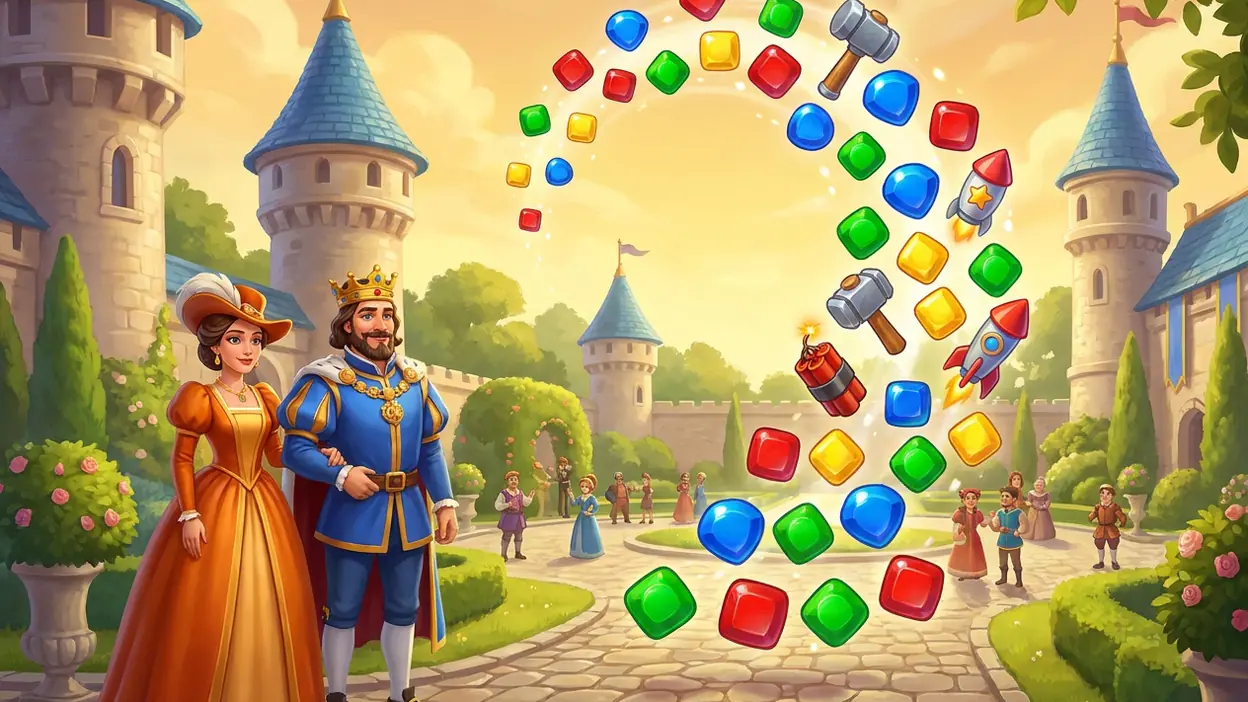
The presentation helps, too. Pieces are bright and easy to read, effects make successful matches feel punchy, and the screen stays legible even when obstacles and special pieces crowd the board. The game quickly teaches you to scan for useful combinations rather than tap at random. That small shift from casual matching to deliberate planning is the opening hook in its most effective form.
How the core loop feels
At its best, the loop has a pleasing three-beat rhythm: inspect the board, make a move that solves an immediate problem, then look for the bigger combination it might create. A straightforward match can clear space; a stronger setup can produce a power-up that sweeps away a cluster of obstacles. When the board cooperates, one well-placed move sets off a chain reaction and turns a tight level into a sudden comeback.
That sense of cause and effect is the game’s central pleasure. You can feel a useful move before you make it: a match near a blocker, a setup that brings pieces together, a special piece waiting to be combined with another. The best boards reward patience without becoming slow. You are thinking, but you are also watching the board tumble and settle, so the payoff arrives almost immediately.
Not every level gives you that clean line. Some boards are more cramped, some objectives demand repeated attention to awkward corners, and the random fall of new pieces can undo a promising plan. That unpredictability is part of match-three’s appeal, but it means a loss can feel less like a lesson and more like bad luck. The game is most compelling when its layout asks you to adapt, not when it simply asks you to try again.
Progression and rewards
Between puzzles, the kingdom provides a useful change of pace. Wins feed into a sequence of restoration tasks, and each completed step makes the broader setting feel a little more finished. The reward is not just another number climbing on a screen; it is the sense that your successful runs have changed the place you are exploring. That gives the level ladder a reason to matter beyond the next unlock.
There is a smart balance in how often the game asks you to return to the board. The puzzle remains the main event, while kingdom progress supplies the connective tissue between runs. For players who enjoy a steady stream of small objectives, this structure is easy to settle into: clear a level, collect progress, make a visible improvement, and see what comes next.
Still, the reward loop is deliberately incremental. You are not rebuilding a kingdom in one dramatic sweep; you are nudging it forward in small steps. That can be motivating if you enjoy gradual completion, but it may feel thin if you want a deeper building system or decisions that change how the world develops. Here, progression is a pleasant reason to keep playing, not a strategy game hidden inside the puzzle.
Why sessions are hard to stop
Royal Kingdom is especially good at making one more level seem reasonable. A board ends quickly, and the next objective is already visible. If you narrowly miss a target, the unfinished challenge stays in your mind; if you win, the reward points toward another task. Either outcome gives you a neat excuse to keep going.
That pacing suits short breaks, but it also makes the game easy to overrun your planned stopping point. The levels arrive in a steady stream, and the kingdom’s gradual transformation creates a second layer of momentum. It is a familiar retention pattern, yet it works because the basic action remains enjoyable. The game does not need every board to be spectacular; it only needs enough of them to feel like a small, solvable challenge.
There is a limit to that momentum. Once the difficulty rises, a run of failed attempts can break the pleasant rhythm. The game’s insistence on another try is most welcome when you can see a better approach. It is less welcome when success seems to depend on a lucky cascade or when you are out of useful moves before the board has opened up.
Style and identity
The art direction leans into polished fairy-tale charm: vivid colors, expressive characters and a world presented with a light, welcoming touch. It does not chase realism or a moody fantasy atmosphere. Instead, it makes the kingdom feel like a cheerful place worth repairing, which keeps the tone aligned with the quick, colorful action of the boards.
That identity is also the game’s comfort zone. Players familiar with Royal Match will recognize the broad appeal of a polished match-three adventure paired with a kingdom setting. The distinction is less about changing the genre than about offering another cast of characters, another world to work through and another progression track to follow. The presentation is inviting, though the overall formula will feel familiar to anyone who has spent time with the genre’s leading names.
Who it is perfect for, and where it frustrates
This is a strong fit for players who want a mobile puzzle game that starts quickly, explains itself clearly and provides a visible reward beyond the board. It suits commuters, casual puzzle fans and anyone who likes the small satisfaction of finishing a level before moving on to the next task. If you enjoy planning a few moves ahead but do not want to manage a complicated system, the balance is comfortable.
It is less suited to players who need every puzzle to feel wholly new. Match-three fans will recognize the familiar ingredients: limited moves, special pieces, blockers, cascading matches and gradual difficulty spikes. The game’s kingdom layer adds context, but it does not transform those mechanics into something unfamiliar. Players looking for the spatial pressure of Block Blast!, the route-planning puzzles of Arrows – Puzzle Escape or the distinct tile-clearing rules of Tile Explorer - Triple Match may find this a more conventional kind of challenge.
The main frustration is the tension between control and chance. Careful planning matters, but falling pieces can shape what options you get next. That mixture can make a hard level exciting, because a fresh cascade may rescue the run, or irritating, because a sensible plan may not be enough. The other drawback is that progress can feel repetitive if the board objectives stop surprising you. The kingdom is a pleasant backdrop, but the puzzles have to carry most of the long-term interest.
Why it is worth installing now
If you are looking for a polished match-three game rather than a radical new take, this is an easy recommendation to understand. The onboarding is quick, the boards communicate their goals well, and the link between winning and improving the kingdom gives the game a clear reason to exist beyond its next level. It is the sort of download that can fill a short break without demanding a long tutorial or a commitment to learn a sprawling system.
Its strongest advantage is the combination of immediate puzzle satisfaction and visible, gradual progress. That pairing gives the game an inviting rhythm from the first stages onward. It also makes the familiar mechanics feel purposeful: every match clears a problem, every win pushes the surrounding adventure forward, and the next task is close enough to tempt you.
Players already devoted to a match-three favorite may not find enough novelty to switch their main game. But if you want a fresh kingdom to restore and a reliable stream of compact puzzles, Royal Kingdom earns a place on your home screen. Its formula is recognizable, its rewards are paced in small steps, and its best boards turn a few quick matches into a surprisingly satisfying little run. Just be prepared for the occasional level that asks for one more attempt than feels fair.