 Article about Ludo King®
Ludo King Makes the Most of the Minutes Between Plans
AppCompare
Group plans now live in chat threads, where someone is always late, someone else is waiting, and nobody has quite enough time to start a film. That is exactly the kind of gap Ludo King® fills. Its appeal is not that it reinvents board games; it makes a familiar, mildly chaotic one easy to start across distance, then easy to pause when real life interrupts. The timing feels right because mobile habits have shifted toward small, shared bursts rather than long, carefully scheduled sessions.
The game’s best trick is still its simplest: a roll of the dice can turn a quiet few minutes into a running argument about whether to chase a rival’s token or take a safer route home. Ludo King® keeps that choice legible and the stakes low. It is a social game you can open without a tutorial, a dedicated console, or an agreement to spend the evening together. That combination makes its old-fashioned board feel newly useful.

Ludo King®
Gametion · 4.1 · Free · Android, iOS
Why a familiar board matters now
Mobile games compete for attention in a crowded day, but not every spare moment calls for a reflex test or an elaborate quest. Many players want something they can understand at a glance and share with people who have different ages, devices, and gaming habits. Ludo does the job because its rules travel well: roll, move, protect your pieces, and try to get them home before everyone else.
That clarity matters in an era of fragmented attention. A match can stretch across interruptions, and a player can grasp the situation without studying a map or learning a long list of abilities. For families spread across cities, friends between errands, or colleagues killing time after a meeting, the game supplies a common activity without requiring much setup. It is less an escape into a separate world than a reason to stay in conversation.
The game also suits the way people make plans now. A group chat can become a game room with a few taps, and the board gives the conversation something to orbit around. Teasing a rival for sending a token back to the start is more immediate than exchanging another reaction to a message. The social payoff arrives through the play itself.
The behavior shift behind the comeback
There is a broader change underneath this kind of appeal: people increasingly fit entertainment around everyday life instead of reserving a large block of time for it. A mobile game has to make sense in a queue, during a break, or while waiting for a friend to join. Ludo’s turn-based rhythm accommodates that pattern better than games that punish a brief absence or demand constant concentration.
Its pace is not entirely slow. A lucky roll can change the board in seconds, and a token near home suddenly becomes vulnerable when an opponent lands on the same square. But between those jolts, players can talk, check a message, and return to the next decision. That alternation between suspense and downtime is the game’s natural rhythm, not a concession bolted onto it.
This is where Ludo King® feels more relevant than a purely solo time-killer such as Subway Surfers. The latter is built around a personal run and quick reflexes; Ludo is built around other people being present, even if they are miles apart. It is not trying to replace every kind of mobile play. It fits a particular modern need: low-pressure company that does not depend on everyone being in the same room.
What makes it timely, and where it helps
The mobile version brings the familiar board into places where setting one up would be impractical. The interface puts the board, dice, and tokens in front of the group; online play lets friends and relatives join remotely, while local play suits people gathered around one device. Players can also face the computer when no one else is available. Those options give the game more than one useful setting, rather than making it depend on a single ideal group.
It helps immediately when a household wants a game that children and adults can learn together, or when a family call needs an activity beyond catching up. It works for friends who want to keep a casual ritual alive across time zones, too. The rules are familiar enough that the explanation can be short, leaving the group to get on with the important business: accusing one another of bad luck and deciding whether a risky move was brave or foolish.
Classic Ludo remains the centre of gravity, but the app includes other board variations, including Snakes and Ladders. That gives returning players something else to try without abandoning the accessible, turn-based format. It is a useful extra, though the core Ludo match is still the reason to install the game; more modes do not automatically make every session better.
Ad-supported free access also lowers the barrier to joining. A friend does not have to buy a board or arrange a game night before taking part. The trade-off is that ads and promotional interruptions can break the relaxed flow, especially when the group wants to move quickly from one match to the next. Ludo is most enjoyable when the app stays out of the way; its commercial layer occasionally reminds you that it cannot always do that.
Who is adopting it fastest?
The fastest adopters are often not dedicated mobile gamers. They are people who already know Ludo from a physical board and want a convenient way to play when the family is apart, plus newer players who see a familiar, colorful board in a shared link or invitation. The game asks very little of either group. A seasoned player can bring the rules; a newcomer can learn by watching a few turns.
That broad accessibility is a strength, but it also shapes the experience. Competitive players looking for deep strategy may find that dice luck dominates too many outcomes. Social players are more likely to enjoy the swings: a token sent back to the start creates a story, even when it feels unfair. The game’s audience is therefore defined less by age than by attitude. If you want conversation and surprise, its simplicity works in your favor; if you want precise control, it can test your patience.
It also serves people who do not share an ecosystem of newer games. Unlike an elaborate online title, Ludo does not ask everyone to master complex controls or build a gaming identity. Compared with utility apps such as Android Auto, Google Maps, or a universal TV remote, it is not solving a practical task in the literal sense. Its utility is social: it gives a group a straightforward reason to spend time together.
Why this feels easier than the old options
A physical board still has a charm a screen cannot reproduce: the dice in your hand, the pieces spread across a table, and the ability to see everyone’s reaction at once. But it requires the board, the people, and the time to line up. Ludo King® removes those logistics. Online matchmaking and invitations can bring players together without a host laying out pieces or checking who owns the set.
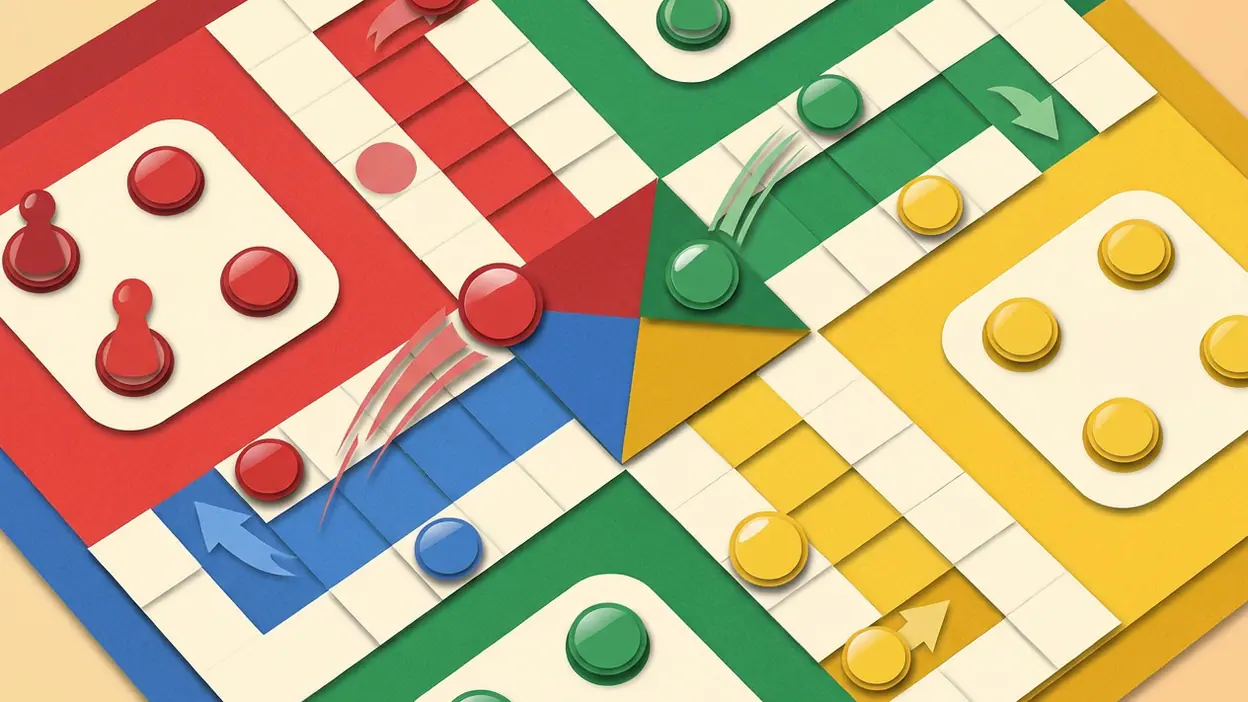
That convenience changes how often the game can happen. A board game that once came out for holidays or visits can now fill an ordinary Tuesday evening. The app’s familiar visual language helps, too. The colored tracks and tokens are easy to read on a phone, and the central board makes the current contest obvious. There is little learning curve between opening the game and caring about the next roll.
Convenience does not make digital play a complete substitute for a table. Online matches lack the shared physical space, and connection problems or mismatched availability can turn a quick invitation into waiting around. Still, for a dispersed group, the phone is not competing with a board set that everyone could use together; it is providing the version that can actually happen.
Where the polish still frays
The central tension is luck. A player can make sensible choices and still watch a rival’s fortunate roll undo a careful lead. That volatility is part of Ludo’s appeal at a casual gathering, but it can feel thin over repeated matches, especially if you want the winner to be determined primarily by skill. The game creates plenty of drama, though not all of it feels earned.
Ads are the clearest interruption. Their presence is understandable in a free-to-play game, but the timing can make a social session feel less spontaneous. Interface prompts and extra options can also crowd a game that works best when its purpose is obvious. I would rather see the route from invitation to first roll remain as clean as the board itself.
Online play depends on the group’s availability and connection, while playing against the computer is useful but cannot recreate the jokes and grudges that make a shared match memorable. The game is at its best with real people who are happy to take turns at an unhurried pace. Without them, the board still functions, but much of its personality goes quiet.
What the trend says, and how long it may last
Ludo’s appeal points to a modest but durable truth about mobile life: people do not only use phones to be entertained alone. They also use them to maintain small rituals with people who cannot be physically present. A short match can become a family habit or a recurring group-chat event. The app’s role is not profound, but that is part of its usefulness. It makes connection feel easy rather than ceremonial.
Its relevance should last as long as the need for quick, shared play does. The exact game may wax and wane in popularity, and new social games will keep arriving, but the ingredients are durable: rules people already understand, turns that tolerate interruption, and enough chance to keep a familiar group laughing. Ludo is not a trend because it is new. It is timely because the way people gather has changed while the pleasure of a simple board game has not.
For casual players, families, and friends who want an easy excuse to keep in touch, Ludo King® earns a place on the phone. Go in expecting a relaxed social game, not a finely balanced strategy contest, and its lucky swings, quick starts, and familiar board make sense. The ads and occasional wait can roughen the experience, but the essential idea remains strong: when people are separated by distance or busy schedules, one roll is often enough to bring them back to the same table.