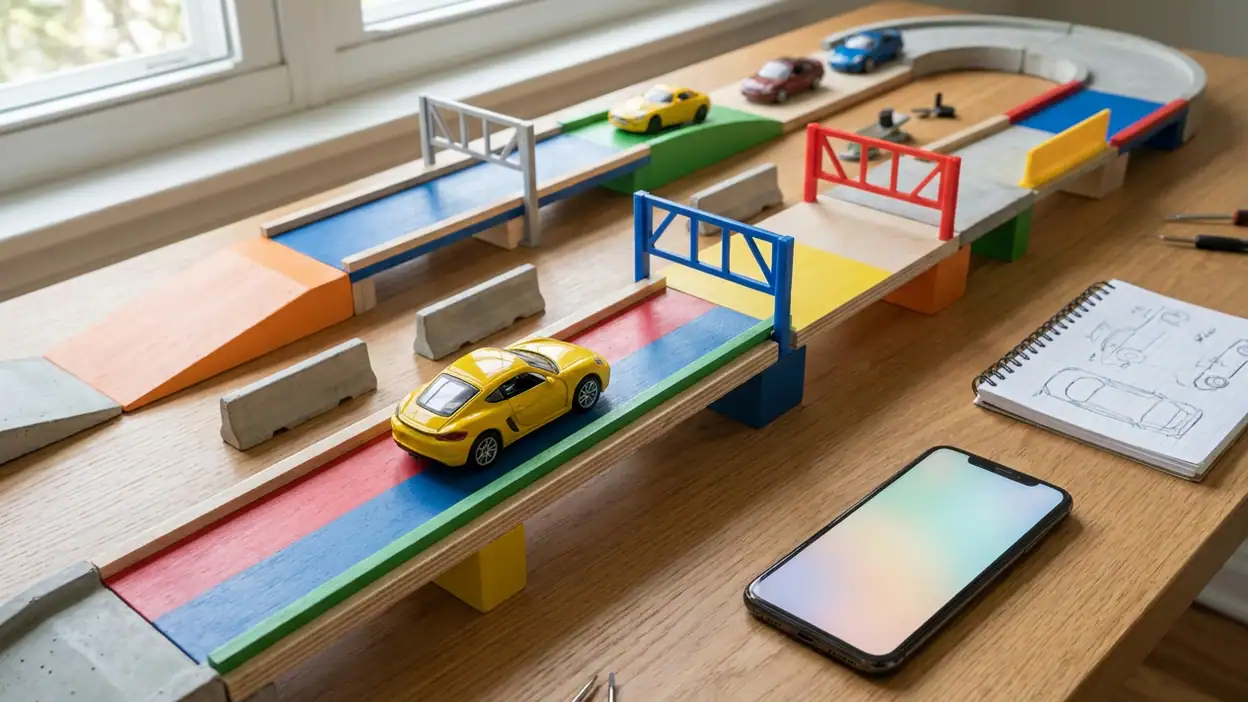
 Article about Race Master 3D: Car Racing
Why Race Master 3D Shows Where Mobile Racing Is Headed
AppCompare
Mobile racing has spent years trying to squeeze console spectacle into a phone, but the more interesting shift is happening in the opposite direction. Players are no longer automatically asking for bigger maps, deeper tuning menus, or a licensed garage full of dream cars. They want a race that starts immediately, communicates its rules clearly, and gives them a reason to try again before the previous attempt has fully faded. Race Master 3D: Car Racing understands that change better than many more ambitious racers, and its real importance is not that it wins every comparison. It shows where the category is moving.
At first glance, Race Master 3D looks almost aggressively simple. You steer a car through compact courses filled with barriers, ramps, moving hazards, rival vehicles, narrow passages, and sudden changes in momentum. The controls are designed for touch rather than simulation: the car accelerates with little ceremony, while your attention stays on steering, timing, and survival. A race can be over in seconds, but that brevity is the point. The game is built around the small, repeatable drama of spotting a gap, committing to it, scraping past an obstacle, and wondering whether the next attempt will be cleaner.

Race Master 3D: Car Racing
Beresnev Games · 4.6 · Free · Android, iOS
Mobile racing is becoming an obstacle course with a garage attached
The category thesis is straightforward: the modern mobile racer must create tension faster than it creates complexity. Traditional racing games still have a place, especially for players who enjoy long events, car statistics, and the fantasy of building a complete motorsport career. Yet the strongest mobile designs increasingly borrow from arcade obstacle courses, endless runners, and bite-sized action games. They make the first decision immediate, keep the screen visually active, and turn failure into a prompt rather than a punishment.
That shift changes what “good racing” means. A technically impressive game can still feel slow if it spends too long preparing the player for the fun. A smaller game can feel more satisfying if every corner asks a readable question. Should you take the inside line and risk clipping the barrier? Is the apparently open lane about to close? Can you follow a rival through a moving gate, or is it safer to lose a little speed and preserve the run? Race Master 3D is less interested in reproducing a real race than in making those questions arrive one after another.
This is why its compact tracks matter more than their limited physical scale might suggest. They are not merely short versions of console circuits. They are sequences of prompts. A course introduces a hazard, lets you understand its rhythm, then combines it with another demand. The result is closer to a playable stunt reel than a conventional lap-based race. The car is the vehicle, but the real subject is the player’s reaction time.
The baseline has moved beyond steering
Players now expect a mobile racing game to satisfy several basic conditions before they will invest attention. It must launch quickly, make its controls understandable without a manual, provide enough visual feedback to explain wins and crashes, and keep early progress moving. A car that feels weightless, a track that looks interchangeable, or a menu that interrupts every attempt can ruin the experience even if the underlying driving is competent.
Race Master 3D meets much of this baseline through restraint. Its control scheme is easy to grasp because it asks for a narrow set of actions. You are not juggling throttle pressure, brake balance, gear changes, and camera angles while also trying to understand a crowded interface. The game puts the emphasis on lateral movement and timing. That simplicity can feel liberating on a phone, particularly when playing one-handed or in a short break.
The baseline also includes a steady sense of reward. Mobile players have become used to progression arriving in small portions: a new car, a visual upgrade, a more difficult stage, or a fresh variation on a familiar challenge. Race Master 3D uses that rhythm to keep its short races connected. Each attempt is disposable in duration but not necessarily in purpose. You are not only trying to finish the current course; you are also nudging the broader run forward.
There is a practical intelligence in this structure. A long race can make a mistake feel expensive. A short race makes experimentation affordable. That distinction is crucial on mobile, where a player may be standing in a queue, waiting for a download, or switching between tasks. The game respects fragmented attention without reducing every moment to empty noise.
The strongest signal is its control over rhythm
Race Master 3D’s strongest signal is not its car collection or its visual polish. It is the way the game controls rhythm. The best runs have a clean musical quality even without relying on a soundtrack: accelerate, shift position, pass an obstacle, recover from a near miss, and immediately prepare for the next interruption. The track keeps asking for a response before the previous response has become comfortable.
That rhythm gives the game its hook. The first few races teach the basic movement, but the real appeal appears when familiar actions begin to combine. A player who has learned to steer around static barriers must then deal with a moving object or a constricted lane. The game does not need a complex physics model to create pressure. It needs reliable timing and enough variation to make the next attempt feel potentially better.
I found that the most satisfying moments came from near misses rather than clean victories. Sliding past a hazard with barely enough room creates a stronger memory than simply reaching the finish line. The game understands the value of visual punctuation: collisions are obvious, successful passes feel immediate, and the course itself acts like a sequence of escalating beats. It is arcade racing stripped down to its most portable form.
That design also explains why the game can be more compelling than its apparent simplicity suggests. There is no need to study a map for several minutes before playing well. The information arrives at driving speed. You see the problem, make a choice, and live with the result. The loop is shallow in the best sense: it is easy to enter, but small improvements remain visible.
What it follows, and why those conventions still work
Race Master 3D follows several established mobile conventions. It uses short sessions, accessible controls, staged progression, unlockable vehicles, and a visual presentation designed to remain readable on a small screen. It also leans on the familiar promise that the next car or the next course will make the journey feel fresh. None of these ideas is new, but their continued usefulness should not be dismissed as formula.
Short sessions work because they match the way many people actually use mobile games. A race that takes less than a minute can fit into a gap that a more demanding title cannot. Accessible controls work because touchscreens are poor substitutes for physical buttons, especially in games that require precise steering. Staged progression works because it turns a sequence of isolated challenges into a path with visible direction.
The game also understands that mobile presentation benefits from strong silhouettes and clean spatial relationships. Obstacles need to be recognizable before the player reaches them. Rival cars need to read as moving pressure rather than decorative traffic. The environment can be colorful and exaggerated, but it cannot become so busy that the player loses the line through the course. This is a convention worth preserving: spectacle should clarify danger, not hide it.
Compared with OTR - Offroad Car Driving Game, Race Master 3D is less interested in the fantasy of open-ended driving. OTR gives players room to roam, climb, and treat the vehicle as a tool for exploring terrain. Race Master 3D narrows the world deliberately. Its fantasy is not freedom across a landscape; it is control inside a carefully arranged trap. That narrower focus lets it spend more of its design budget on timing and surprise.
It also shares DNA with Car Race, where direct movement and immediate competition matter more than elaborate simulation. But Race Master 3D pushes the course design toward spectacle. The question is not simply whether you can overtake another car. It is whether you can maintain control while the track behaves like an obstacle machine.
The convention it challenges is the long race as the ultimate test
The most interesting convention Race Master 3D challenges is the assumption that a serious racing game needs long events to create meaningful skill. In traditional racing, endurance and consistency are central. You manage tires, learn braking points, protect a lead, and recover from mistakes over several laps. That can be deeply rewarding, but it is not the only way to make driving feel demanding.
Race Master 3D argues for a different test: can you make a correct decision under constant compression? Its races do not ask whether you can maintain concentration for ten minutes. They ask whether you can process a sequence of hazards without freezing, overcorrecting, or becoming greedy. The skill is compact, but it is not necessarily shallow.
This approach has consequences for replay value. A long race often encourages mastery through route knowledge and pace management. A short obstacle race encourages mastery through cleaner execution. You replay because the last attempt was almost right. That “almost” is powerful. It turns failure into a personal challenge rather than a simple loss.
The challenge to convention is not complete, however. The game still relies on familiar progression mechanics and a steady stream of unlocks to extend the experience. Its innovation is therefore structural rather than revolutionary. It changes the size and rhythm of the challenge, not the entire economic or social model of mobile racing.
What the neighboring games reveal
The wider category makes Race Master 3D easier to understand. Epic Race 3D – Parkour Game is not a car racer in the strict sense, but it shares the same appetite for compact hazards, readable timing, and visually obvious failure. Its presence in the same mobile conversation shows how easily racing mechanics now blend with obstacle-course design. Movement itself is becoming the common language, while the vehicle, runner, or stunt performer becomes a skin over that language.
Hill Climb Racing 2 points in another direction. Its enduring appeal comes from physics, terrain, vehicle balance, and the comic risk of flipping at exactly the wrong moment. It creates personality through motion. Race Master 3D is more controlled and less physically expressive, but both games understand that a mobile racer needs a memorable relationship between input and consequence. You should feel that your mistake came from a decision, not from an invisible rule.
Need for Speed No Limits represents the premium spectacle model: licensed cars, dramatic presentation, deeper customization, and a stronger connection to established racing culture. It gives players the fantasy of owning and improving recognizable machines. Race Master 3D offers a different fantasy, one built around instant competence. You do not need to understand a tuning system or care about a particular manufacturer to enjoy the next run.
These games reveal a market splitting into several valid forms. There is the open-world explorer, the physics toy, the obstacle sprint, the arcade racer, and the presentation-heavy car collection. The category is not converging on one ideal game. It is converging on a shared expectation that the core interaction must become legible and rewarding almost immediately.
That is where Race Master 3D makes its clearest contribution. It does not attempt to beat every rival at depth, authenticity, or content volume. Instead, it makes a strong case for the value of a focused loop. A mobile racing game can be memorable because it creates a particular kind of pressure and repeats that pressure with enough variation to keep the player curious.
The emerging standard is frictionless intensity
The emerging standard for mobile racing is what I would call frictionless intensity. The player should reach the meaningful decision quickly, understand the result instantly, and be able to try again without navigating a maze of interruptions. This does not mean every game must be minimal. It means every layer outside the core drive has to justify its presence.
Race Master 3D gets close to that standard because its main loop is always visible. The car moves, the course changes, and the player reacts. There is little distance between intention and consequence. That clarity is more valuable than a large feature list when the game is played in short bursts.
The standard also includes visual variety without overwhelming complexity. A new stage should not merely change the background color. It should alter the way the player reads space, anticipates movement, or manages risk. Race Master 3D’s best moments come when environmental changes affect the decision rather than simply decorating it.
Another emerging expectation is that replay value must be built into the moment-to-moment loop, not added only through a leaderboard or a distant achievement. The player should want to repeat a course because the run itself can be improved. Race Master 3D benefits from that instinct. Its compact challenges make the difference between a messy finish and a clean one immediately apparent.
For developers, this is a demanding standard. It requires better pacing, clearer feedback, and more disciplined level design. A game cannot hide weak interaction behind a large garage forever. Players may enjoy unlocking cars, but they return because driving feels good.
Where the category still falls behind
The category’s biggest weakness is that many games mistake volume for depth. More cars, more currencies, more menus, and more event types can create the appearance of richness without improving the actual drive. Race Master 3D avoids some of that clutter through its focused structure, but it is not immune to the limitations of the format.
Its simplicity can become repetition. Once the player has learned the basic logic of the obstacles, the surprise weakens unless the game continues to introduce meaningful variations. A new color or a slightly different arrangement is not enough. The strongest future versions of this design will need hazards that change the player’s priorities, not merely the scenery around them.
There is also room for a more expressive sense of vehicle identity. The cars function primarily as tools for the loop, which keeps the game accessible but reduces the emotional attachment that games such as Need for Speed No Limits cultivate. Players may enjoy a quick run without ever developing a favorite machine, a preferred handling style, or a reason to care about the vehicle beyond its upgrade path.
Mobile racing also continues to struggle with monetization pressure. Even a well-tuned game can lose trust if rewards, interruptions, or upgrade gates make the player feel that the ideal experience is being withheld. The category’s future depends on respecting the difference between a satisfying pause and a forced delay. A short game should feel quick because its design is efficient, not because it is constantly asking for another transaction.
Finally, accessibility remains uneven. Simple controls do not automatically mean broad accessibility. Players may need adjustable sensitivity, clearer visual contrast, reduced motion options, and more flexible control layouts. The next standard should treat those features as part of good racing design rather than optional polish.
What this means for players
For users, the consequence is encouraging: you no longer need to choose between a shallow time-killer and an exhausting simulation. The category now contains more middle ground. A game like Race Master 3D can deliver a concentrated burst of driving tension without demanding a long session or a detailed understanding of motorsport systems.
That makes it especially suitable for players who care about responsiveness and replayable challenges more than realism. If you want to explore a landscape, OTR - Offroad Car Driving Game is the better fit. If you want physics-driven comedy, Hill Climb Racing 2 has a stronger personality. If you want licensed cars and a more elaborate progression framework, Need for Speed No Limits remains the obvious direction. But if you want a quick sequence of visual problems that can be solved through timing and steering, Race Master 3D knows exactly what it is.
It also changes how players can judge a racing game. Instead of asking only how many cars or tracks are included, ask whether the next attempt feels inviting. Does the game explain failure? Does the course create anticipation? Does a successful maneuver feel earned? Does the loop remain enjoyable when the reward screen is removed from the equation? Those questions are more revealing than a feature checklist.
My main reservation is that the game’s strengths can become its ceiling. The same streamlined design that makes it easy to pick up can limit the depth available to players who want long-term mastery. It is excellent at creating a quick pulse of concentration, less convincing as a complete racing hobby. That is not a contradiction; it is the trade-off that defines the experience.
The road ahead
The category outlook is less about one dominant format than about sharper specialization. Open-world driving games will continue to sell freedom. Simulation-minded racers will continue to serve players who want authentic handling and detailed progression. Physics games will keep turning vehicles into expressive toys. Alongside them, obstacle-focused racers will become more confident about treating the track as a sequence of interactive set pieces.
Future games in this space should learn from Race Master 3D’s economy without copying its surface. The lesson is not simply to make races shorter or controls simpler. The lesson is to make every second carry a clear purpose. A hazard should test something. A new vehicle should change the feel of a run. A reward should support the next decision rather than distract from it.
The best mobile racers will probably combine this immediacy with stronger long-term identity. Imagine the compact intensity of Race Master 3D joined to the terrain personality of Hill Climb Racing 2, the exploration of OTR, or the vehicle culture of Need for Speed No Limits. That combination could produce games that are easy to enter but difficult to exhaust.
For now, Race Master 3D is valuable because it captures a category in transition. It follows the familiar mobile recipe of short races, unlocks, and accessible controls, but it also makes a sharper argument about what racing can be on a touchscreen. The race does not need to be long to be tense, and the car does not need to be realistic to make the player care about the next turn.
That is the game’s clearest editorial verdict: mobile racing is moving away from the idea that scale alone creates value. The future belongs to games that understand attention, build pressure quickly, and make improvement visible. Race Master 3D does not solve every problem in the category, and its repetition will test players who want deeper systems. But as a compact statement of the new standard, it is remarkably clear. The best mobile race may be the one that gives you just enough time to think, then asks you to react.