 Article about FPS Strike Ops : Modern Arena
What FPS Strike Ops Reveals About the Future of Mobile Arena Shooters
AppCompare
Mobile shooters no longer have to prove that a phone can handle a firefight. That argument ended years ago. The more interesting question is what a modern arena shooter should feel like after the novelty has worn off: how quickly it gets players into meaningful action, how clearly it communicates danger on a small screen, and whether each match leaves enough unfinished business to justify another round. FPS Strike Ops : Modern Arena is useful precisely because it sits inside that transition. It is not simply another game with guns, compact maps, and short matches. It is a snapshot of a category trying to become sharper, faster, and more respectful of the player's time without losing the rough excitement that made mobile action games popular in the first place.
That makes it more revealing than a straightforward winner's review. The game has the familiar ingredients: first-person movement, modern combat spaces, opponents arriving from multiple angles, and a loop built around learning the arena through repetition. Yet those ingredients now carry different expectations. Players have been trained by competitive games to demand immediate responsiveness, by social platforms to expect constant variety, and by premium console releases to notice every awkward animation, muddy sound cue, or empty progression screen. A mobile FPS can still be simple, but it cannot feel careless.

FPS Strike Ops : Modern Arena
FPS Shooter & Action Game · 4.6 · Free · Android, iOS
Mobile arena shooters are being judged by rhythm, not spectacle
The category thesis is straightforward: the new baseline for a mobile shooter is a reliable combat rhythm, not a large feature list. The best games create a clean sequence of decisions. Spawn, read the space, choose a route, meet an opponent, react under pressure, recover, and try again with better information. Everything else exists to support that sequence. Menus, unlocks, cosmetics, missions, and matchmaking matter, but they are secondary to the quality of the few seconds between seeing an enemy and deciding whether to push, retreat, or hold position.
FPS Strike Ops understands that rhythm better than many mobile games that advertise themselves with louder weapons and more elaborate menus. Its appeal comes from the compactness of the encounter. You are not wandering through a huge world waiting for the game to become interesting. The arena keeps presenting small problems: a corridor that may be watched, a corner that may conceal an opponent, a route that appears safe until footsteps or gunfire change the calculation. The game is at its best when it turns limited space into pressure.
This is also where the adventure label becomes useful, even if the game is primarily a shooter. Adventure on mobile increasingly means movement through a chain of readable situations rather than a single uninterrupted story. The player is pushed forward by curiosity, risk, and the promise that the next space will demand a slightly different response. FPS Strike Ops borrows that structure in miniature. Its arenas are not sprawling journeys, but they create a succession of tactical rooms, sightlines, and reversals.
The baseline players now expect
Current expectations begin before the first shot. A mobile shooter has to explain its controls quickly without making the opening feel like a tutorial prison. Touch input must be configurable enough for different hands and screen sizes. Camera movement needs to feel direct rather than slippery. Enemies must be visible against their surroundings, and incoming damage must be legible before the player is already dead. These are not luxuries. They are the basic language of the format.
FPS Strike Ops leans into immediate access. Its premise is easy to understand, and the core loop does not bury itself under a long narrative introduction. That matters because mobile players often arrive in fragments of time. They may have ten minutes, not an evening. A game that spends the first session explaining its universe instead of delivering a satisfying encounter is already fighting the device it lives on.
The second baseline is match density. Players expect a meaningful decision almost immediately after loading in. Long empty runs, slow recovery periods, and maps designed for hardware with more screen space can make a mobile shooter feel strangely inactive. The modern arena format answers that problem with concentrated spaces and frequent contact. FPS Strike Ops follows that convention, keeping the action close enough that the player is rarely allowed to forget the opposing team or the next threat.
The third baseline is clarity. On a phone, visual noise is expensive. A dramatic environment can become a liability if it hides opponents, obscures routes, or makes every surface compete for attention. Successful mobile shooters use lighting, silhouettes, sound, and interface signals as practical tools rather than decoration. The player should understand why a death happened. If the answer is only that the screen was busy, frustration replaces learning.
The strongest signal from FPS Strike Ops
The strongest signal here is its commitment to short-form combat that still asks for attention. The game does not treat a quick match as disposable. Its compact encounters reward a modest amount of spatial memory. After a few rounds, familiar routes begin to acquire meaning. A doorway becomes a likely ambush point; an exposed lane becomes a gamble; a flank becomes attractive only after the opposing side repeats the same defensive habit.
That is the difference between speed and haste. Haste throws enemies at the player and calls the result excitement. Speed creates enough pressure for decisions to matter while keeping the downtime low. FPS Strike Ops is most convincing when it finds that middle ground. The match can be entered casually, but surviving it requires more than pointing at the nearest target. The arena gradually becomes a mental map, and that map is where replay value begins.
I also appreciate the game's refusal to pretend that mobile play needs to imitate a full desktop session. Its scale is part of its identity. The arenas feel built around repeated contact rather than long tactical rotations, and that creates a different kind of mastery. You are not studying a giant competitive ecosystem. You are learning a handful of dangerous relationships: where pressure gathers, which approach exposes you, and how quickly a winning position can become a trap.
The conventions it follows
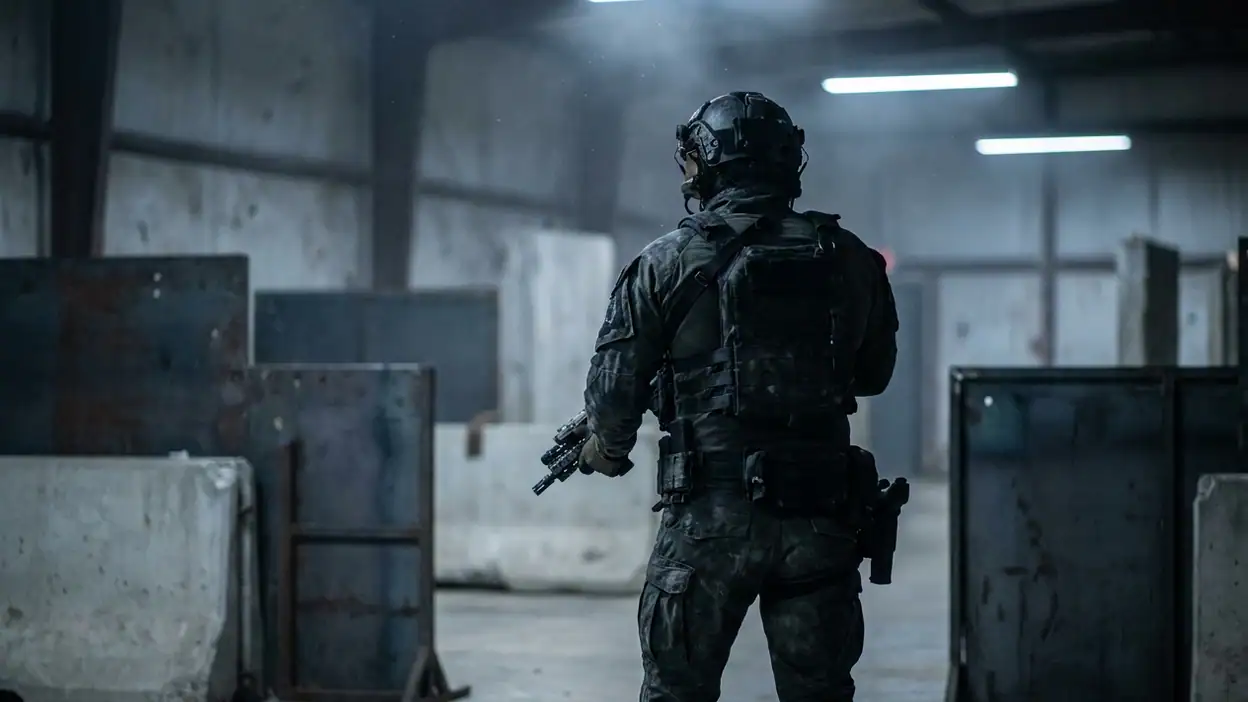
FPS Strike Ops follows several established conventions because they remain effective. The first is the modern combat frame: familiar weapons, industrial or urban spaces, and a visual language built from concrete, metal, cover, and hard artificial light. This setting is not original, but originality is not always the point. The advantage of a recognizable arena is that players can spend their attention on movement and positioning instead of decoding a fantasy rulebook.
It also follows the convention of immediate weapon familiarity. A rifle should behave like a rifle in the broad sense, while a close-range weapon should change the player's confidence and route choices. That shared vocabulary lowers the barrier to entry. Players who have touched other shooters can begin making decisions at once, even before they understand every detail of the game.
The progression structure is familiar too. Matches feed into improvement, and improvement is connected to new equipment, better performance, or a stronger sense of control. This is the standard mobile answer to the question of why players should return after they have seen the maps. It works, but only if the rewards reinforce play rather than substitute for it. A new item cannot rescue a loop that feels flat.
Finally, the game embraces the arena shooter's repeated reset. Each round gives the player a chance to discard a bad opening, test a different route, or recover from a careless decision. That reset is essential on mobile. It keeps failure from becoming a long-term burden and makes experimentation affordable.
The convention it challenges
Where FPS Strike Ops pushes back is against the idea that a mobile shooter needs to inflate itself to appear substantial. It does not need a giant open world, a sprawling cast, or a complicated campaign to justify its existence. Its more modest structure suggests that a game can feel complete through the quality of its encounters. That is a quiet challenge to a market that often confuses quantity with depth.
The challenge is not entirely successful, and that is important. A focused arena shooter can become repetitive if its maps, enemy behavior, and progression do not keep producing new decisions. The same compactness that makes a match accessible can make the game feel narrow after extended sessions. FPS Strike Ops sometimes exposes this tension. It is good at getting to the point, but getting to the point repeatedly means the point has to remain sharp.
There is also a challenge to the convention of constant spectacle. A mobile FPS does not need every encounter to arrive with explosions, dramatic camera movement, or an overloaded interface. Quiet information can be more valuable: a distant footstep, a missing teammate, a suspiciously empty lane. The game's strongest moments come from anticipation rather than visual excess. That restraint feels increasingly important as mobile games become more technically ambitious.
What related games reveal about the wider category
The surrounding mobile landscape makes the shift easier to see. Roblox demonstrates that players now expect creation, social presence, and an almost endless supply of changing contexts. Its appeal is not based on one perfect match but on the feeling that the next experience may be radically different from the last. FPS Strike Ops cannot compete with that breadth, nor should it try. Its lesson is narrower: a focused game must make its central activity considerably more satisfying than a platform's average activity.
Pokémon GO shows another expectation: the game can extend beyond the screen and become part of a player's routine. Exploration, collection, location, and social participation give the loop a life outside individual sessions. For an arena shooter, the equivalent is not walking through a neighborhood. It is making each return feel connected to a personal goal, a skill target, or a social rivalry. Without that connection, short matches risk becoming interchangeable.
Dragon Mania Legends and Super Bear Adventure point in a different direction. Both rely on accessible progression and a clear sense of place. Their worlds are easier to read emotionally than the typical modern combat arena, and their rewards often communicate progress in a more visible way. FPS Strike Ops borrows the accessibility but not the same warmth. Its environment is functional, which supports combat, yet it gives the game less personality between firefights.
Sonic Forces: PvP Battle Race is a useful contrast because it turns competition into spectacle and movement. Its races communicate momentum instantly, while FPS Strike Ops communicates danger through angles, cover, and reaction time. Both depend on quick sessions, but they prove that short-form multiplayer does not have to mean one fixed tempo. The emerging category is not simply fast. It is flexible enough to make speed, suspense, and recovery feel distinct.
These comparisons reveal a common pressure. Players now expect a game to have a strong identity beyond its genre label. A shooter needs more than shooting. It needs a reason to be this shooter, on this device, with this rhythm. FPS Strike Ops has a credible answer in its tight arenas and direct action, but its identity would be stronger if the world around those arenas carried more character.
The emerging standard is respectful friction
The next standard for mobile arena games is not frictionless design. Total smoothness can make a game forgettable. The better target is respectful friction: difficulty that comes from a decision the player could understand, not from a control problem, unclear rule, or monetized obstruction.
FPS Strike Ops points toward that standard through its emphasis on readable encounters. When the game works, the player can identify the mistake. Perhaps the route was too exposed. Perhaps the reload happened at the wrong moment. Perhaps an opponent was allowed to control the strongest angle. That kind of failure invites another attempt because it contains information.
Respectful friction also applies to time. A match should be short enough to fit into a break but substantial enough to produce a story: an early mistake, a recovery, a tense final exchange, or a new route discovered by accident. The strongest mobile games understand that a session is not measured only in minutes. It is measured in remembered moments. FPS Strike Ops creates those moments through pressure rather than narrative, which is a legitimate and often effective approach.
Another part of the emerging standard is transparent progression. Players are increasingly alert to systems that make the core game feel deliberately incomplete so that upgrades can appear more valuable. A competitive shooter should make skill visible. Equipment can add variety, but it should not erase the relationship between practice and performance. The more clearly a game communicates that relationship, the more durable its audience becomes.
Where the category still lags
Mobile shooters still lag in three connected areas: long-term variety, social texture, and environmental personality. The first is the most obvious. Compact maps are efficient, but efficiency can become sameness. New weapons help only temporarily if they are used in the same spaces against the same patterns of behavior. The category needs more forms of tactical change, not merely more items.
Social texture is also underdeveloped. A scoreboard can show who won, but it does not automatically create a community. Players want reasons to recognize one another, cooperate, compete, and return together. That might mean better team communication, more expressive post-match spaces, or events that alter how familiar arenas are played. The social layer should support the combat loop instead of sitting beside it like a separate menu.
Environmental personality is the quieter problem. Many mobile shooters use the same vocabulary of warehouses, military compounds, shipping yards, and abandoned facilities. Those places are readable, but they rarely stay in the memory. FPS Strike Ops benefits from functional clarity, yet it would gain lasting identity from arenas with stronger local details, more varied soundscapes, and visual landmarks that do more than mark a route.
There is a technical lag as well. Touch controls remain a compromise, and not every game gives players enough control over sensitivity, button placement, aim assistance, or visual feedback. A serious mobile shooter should recognize that its audience includes both casual players and people who will tune every setting they can find. Accessibility and competitive precision are not enemies. Good configuration allows both to exist.
What this means for players
For users, the consequence is a healthier but more demanding market. You no longer have to accept a shooter simply because it runs on a phone. There are enough alternatives to judge the whole experience: the opening minute, the fairness of a death, the usefulness of an upgrade, the quality of a rematch, and the feeling left after an hour.
FPS Strike Ops is strongest for players who want direct action without committing to a sprawling campaign. It provides a clear route into the genre and enough tactical texture to reward attention. The game is easy to pick up, but its best moments are not mindless. They come from recognizing a pattern a second earlier than the opponent or choosing restraint when the obvious move is to rush.
Its limitations become clearer during longer sessions. The focused structure can begin to feel familiar before the player has exhausted the possibilities of the genre. Those who want a rich social world may find Roblox more expansive. Players seeking routine, collection, or exploration may find Pokémon GO more persistent. Anyone looking for a brighter adventure tone has alternatives such as Super Bear Adventure. That does not weaken FPS Strike Ops; it defines its proper audience.
The practical lesson is to treat the game as a concentrated competitive snack, not as a replacement for every kind of mobile entertainment. It works best in bursts, especially when the player is willing to learn the arena instead of treating every death as random. The game rewards a small investment of attention and does not always reward endless repetition. Knowing that distinction makes the experience more satisfying.
The category outlook
The future of mobile arena shooters will not be decided by who adds the most weapons or the largest map. It will belong to games that make their limits feel intentional. A small arena can be more memorable than a huge world if every corner has tactical meaning. A short match can carry more weight than a long campaign if its decisions are clear and its outcome feels earned.
FPS Strike Ops shows that the category is moving toward precision. It takes the familiar first-person framework and asks how little ceremony is needed before the action becomes compelling. That is a valuable question, even when the answer exposes the game's own need for more variety and personality. The next generation of mobile shooters will likely keep this directness while adding stronger social systems, more expressive environments, and progression that respects player intelligence.
The stale convention is not the presence of guns, arenas, or short matches. It is the assumption that those ingredients are enough. They are not. Players now notice whether a game has a distinct rhythm, whether its spaces teach them something, and whether its replay value comes from mastery rather than habit. FPS Strike Ops earns attention because it understands the first two parts of that equation. Its remaining challenge is to make the third last longer.
That leaves the game in an interesting position. It is not the final form of the mobile shooter, but it is a clear sign of where the form is heading: faster onboarding, cleaner combat, less wasted time, and more pressure on developers to make every repeat encounter count. For players, that is good news. The bar is no longer set by whether a phone can run a firefight. It is set by whether the firefight is worth remembering.