 Article about My Talking Tom
Switching to My Talking Tom: Is Its Daily Rhythm Worth It?
AppCompare
Switching from a familiar virtual pet is less like downloading a new game and more like moving into a different apartment: the furniture looks familiar, but your hands no longer know where everything is. My Talking Tom is an easy recommendation for players who want a lively pet, quick mini-games, and a steady stream of small rewards, but it is not automatically a better home for everyone coming from Pou, My Talking Angela, or even a completely different casual habit such as Candy Crush Soda Saga. The real question is whether Tom's rhythm fits the time you already give to mobile games.
I tested it with that switching problem in mind rather than treating it as a first-time novelty. The central finding is straightforward: My Talking Tom rewards frequent, short visits and playful interaction, while some alternatives feel more like a quieter pet simulator or a focused puzzle session. Moving over is simple at the installation level, but the meaningful migration happens in your routine. You are deciding what to check, how often to return, and whether feeding, cleaning, dressing, mini-games, and coins feel like a satisfying loop instead of another set of chores.

My Talking Tom
Outfit7 Limited · 4.3 · Free · Android, iOS
How to Decide Whether My Talking Tom Deserves Your Habit
Why consider switching at all?
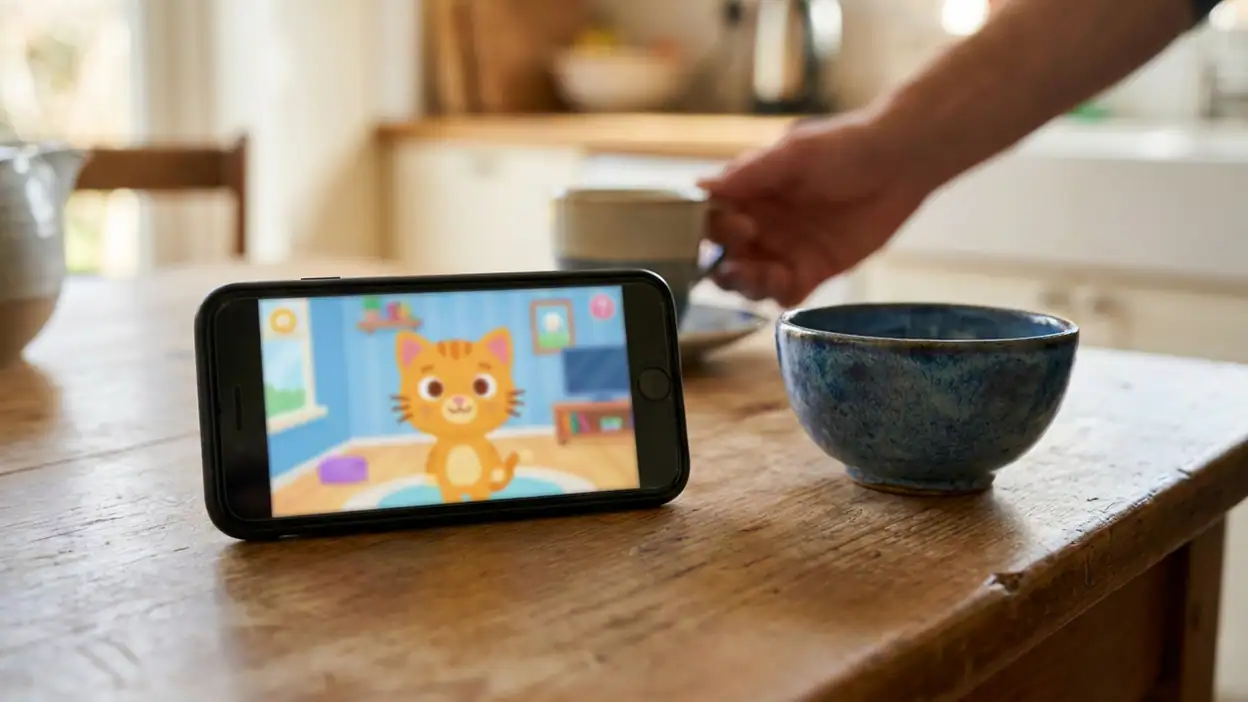
The strongest reason to try Tom is energy. He reacts to taps, sounds, food, and attention with the exaggerated timing that made the Talking Tom series culturally recognizable in the first place. A pet that merely waits for maintenance can become background noise; Tom is more successful when you want the pet to perform back. His expressions and vocal reactions turn ordinary actions into tiny comic beats, and that gives the opening minutes more personality than a typical checklist-driven virtual pet.
There is also a useful middle ground between a toy and a progression game. You can drop in for a quick feeding session, play a mini-game, collect currency, adjust Tom's appearance, and leave without needing a long uninterrupted run. If you are leaving Pou because its routine has become too predictable, Tom supplies more movement and spectacle. If you are leaving My Talking Angela because you want a simpler character relationship, Tom can feel more direct and less socially framed.
The case is weaker if your current game already gives you exactly the right amount of friction. Candy Crush Soda Saga, for example, is built around a clear puzzle objective and a familiar win-or-lose rhythm. Tom does not replace that tension. His rewards are softer, his failures are usually less consequential, and much of the pleasure comes from repetition with variation. Switching makes sense only if you want a companion-like game rather than a level-based challenge.
The first habit that changes
The first change is not the controls. It is the reason you open the game. In a puzzle game, you usually arrive with a task: clear a board, beat a score, or use a limited set of moves well. In a virtual pet game, you arrive to inspect a small living routine. Is Tom hungry? Is he tired? Is there something new to collect? That shift from objective-first play to check-in-first play is the main psychological adjustment.
My routine became more fragmented. Instead of one concentrated session, I found myself returning for several short visits, especially when I had a spare minute. Feeding and basic care are quick, while mini-games provide a longer stop when I wanted one. This structure is convenient, but it also asks for a different kind of commitment. Tom is designed to be remembered throughout the day, not conquered in a single sitting.
Players coming from Pou may recognize the broad pattern immediately, yet the tone changes the habit. Pou can feel like a personal project that you quietly maintain. Tom pushes more feedback toward you: sounds, facial reactions, and playful responses make each interaction more performative. That is appealing if you enjoy visible acknowledgment, but it can become noisy if you prefer a calm, low-pressure pet.
Setup and migration facts
Installation is uncomplicated on a supported Android or iOS device, and the basic transition requires no elaborate technical process. You download the game, launch it, and begin a new in-game routine. The important limitation is equally simple: do not assume that progress, items, currency, or a pet from another title can be imported into Tom. Pou, My Talking Angela, and Candy Crush Soda Saga are separate games, and a normal download should be treated as a fresh start unless the developer explicitly states otherwise for your particular account and platform.
That means the migration cost is mostly emotional and practical rather than logistical. You are not rebuilding a saved pet inside Tom; you are deciding whether you are willing to start a new collection, unlock new looks again, and learn another reward economy. Before deleting an old game, check its own account and cloud-save arrangements if your progress matters. Do not uninstall a familiar title on the assumption that a new installation will preserve anything across products.
There is another small setup consideration: permissions, notifications, advertising, and optional purchases can shape the first impression. Review what the game requests and adjust notifications if repeated reminders feel intrusive. Tom works without turning every visit into a spending decision, but the presence of optional monetization is part of the environment. A careful switcher should decide in advance whether the game is staying within a free-play boundary.
The relearning cost
The controls are easy; the economy takes longer. You quickly understand how to tap Tom, choose activities, and move between care and play. What takes time is learning which actions are worth doing first, how frequently rewards appear, and how much currency to reserve for customization rather than immediate convenience. This is not a difficult game, but it has a rhythm that becomes efficient only after several sessions.
Players moving from My Talking Angela may need to adjust their expectations about presentation and character focus. The underlying idea is familiar, but the feel is not identical. Tom's appeal leans heavily on comic reaction and direct interaction. Players moving from Pou may find the transition easier conceptually, though the visual tone and responsiveness still alter the pace. From Candy Crush Soda Saga, the relearning cost is larger because there is no comparable board-solving language to carry over.
The good news is that mistakes are rarely punishing. You can experiment without studying a guide, and the game communicates its basic needs clearly. The bad news is that the lack of serious consequences can make the loop feel shallow if you are looking for mastery. You learn the system quickly, then decide whether the pleasure of repeating it is enough.
What improves immediately
The immediate improvement is character presence. Tom feels more like an active performer than a static menu with a face attached. His reactions give feeding and ordinary care a little timing, and that timing matters because it makes the first few sessions feel personal rather than administrative. Even when an action is mechanically simple, the response helps it land as an interaction.
Variety also arrives quickly. Care activities, mini-games, customization, and room changes break up the routine more effectively than a single repeated maintenance action. The mini-games are not deep enough to replace a dedicated arcade collection, but they provide a useful change of pace. I especially appreciated having something to do after the basic pet tasks were complete, because it kept the session from ending at the exact moment the chores were finished.
Tom is also a strong choice for players who want low-stakes play. There is no need to protect a long competitive streak or solve a demanding puzzle before the game feels rewarding. You can play for a minute, make visible progress, and leave. That immediate accessibility is the clearest reason to switch from a more demanding casual game.
What may be lost
Switching can cost you depth. If you are leaving Candy Crush Soda Saga, you may miss the clean satisfaction of a board that resists you and then finally gives way. Tom's challenges are lighter, and his progress is more about accumulation than breakthrough. There is less of that sharp moment when careful planning produces a difficult win.
You may also lose the attachment built around an existing pet. Familiar animations, unlocked outfits, room arrangements, and accumulated currency have value even when they are digital. Starting again can feel refreshing for a week and strangely empty after the novelty fades. This is especially true if your current game has become a quiet record of months of small decisions.
There is a subtler loss: a virtual pet can turn free time into maintenance. The game is friendly about it, but the repeated needs still create a gentle obligation. If you already feel overcommitted to daily check-ins, adding Tom may not solve the problem. It may simply give the same habit a brighter face.
A sensible parallel-use strategy
The safest switch is not a switch at first. Keep your familiar game installed and give Tom a defined trial period, perhaps a week, without trying to recreate every old routine immediately. Use Tom at the times you would realistically have available rather than forcing extra sessions to justify the download. This reveals whether the game fits your life or only feels exciting because it is new.
During that trial, separate the roles. Let Tom handle short, playful check-ins, while a puzzle game remains your choice for focused challenge. If you are comparing him with Pou, alternate them on different days instead of maintaining both pets every few hours. That prevents the experiment from becoming two identical obligations.
Pay attention to three signals: whether you return without reminders, whether the care loop feels pleasant after the novelty wears off, and whether mini-games give you a reason to stay longer. If all three are positive, a fuller switch is reasonable. If you only open Tom to collect something and immediately leave, the game may be functioning as a notification habit rather than a genuine replacement.
Reasons to stay put
Stay with Pou if you value a quieter, more self-directed virtual pet and already enjoy the progress you have built. Familiarity is not a failure of imagination; it is part of a game's value. If the existing routine feels relaxing rather than stale, Tom's extra animation and feedback may register as clutter.
Stay with My Talking Angela if the character, customization, and established style already match what you want from a companion game. The broad category overlap does not make the experiences interchangeable. A new title should earn the space on your phone by changing your enjoyment, not merely by presenting another version of the same premise.
Stay with Candy Crush Soda Saga if your main pleasure is structured challenge. Tom can sit beside it, but he will not reproduce the anticipation of a difficult level, the satisfaction of a clean combo, or the long-term chase of puzzle progression. Switching categories is worthwhile only when your appetite has changed.
The best switching candidate
The ideal switcher is someone who has grown tired of a rigid daily routine but still wants a casual game with a recognizable character. This player enjoys short sessions, likes collecting and decorating, and does not need every interaction to test skill. They want a game that can be funny for thirty seconds and mildly absorbing for fifteen minutes.
Tom is also a good fit for households where a simple, readable game matters. The controls are approachable, the goals are easy to understand, and the character's reactions make the result visible without requiring specialist knowledge. That does not make the game exclusively for children; adults who want a low-pressure break can appreciate the same clarity. It does mean that players seeking complex strategy should look elsewhere.
The weakest candidate is the completionist who treats a long-established collection as sacred. Starting over may be more irritating than rewarding, particularly if the old game already supplies enough customization and daily variety. In that case, Tom should be a side experiment, not a replacement.
Switch or stay?
My verdict is to switch if your current game feels like a task and you want a more animated, reactive companion. My Talking Tom makes the basic virtual-pet loop feel lively through character performance, quick activities, and a flexible session length. Its best quality is not complexity; it is the way small actions acquire personality. That is enough to justify a move for the right player.
Do not switch expecting imported progress, a deeper puzzle system, or a dramatic reinvention of virtual pets. The migration begins from zero, the economy takes a little learning, and the long-term loop can become repetitive once the first burst of novelty fades. Tom is at its strongest when treated as a playful daily visitor, not as a demanding game that must constantly deliver new mastery.
The practical choice is simple: trial Tom beside your current favorite, then keep it only if you begin opening it for the character rather than the rewards. If that happens, the move has worked. If not, staying put is the more honest decision, because a familiar game that still fits your routine is better than a fresh download that merely imitates the habit you were trying to escape.