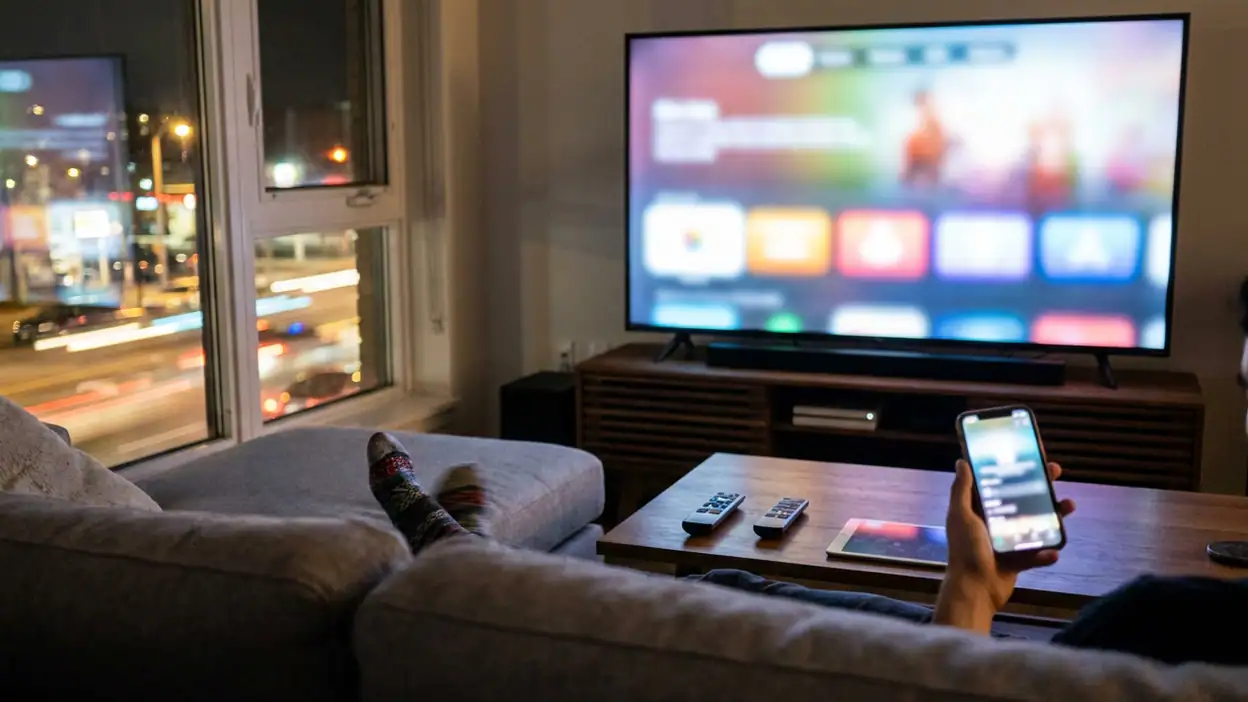
 Article about Google TV
Why Google TV Makes Streaming Easier to Navigate
AppCompare
Most streaming apps want to be the loudest room in the house. They fill the screen with premieres, autoplay trailers, celebrity faces and urgent little signals that something important is happening right now. Google TV takes a more useful position: it behaves less like another channel and more like a thoughtful front desk for the channels you already have.
That distinction sounds modest, but it changes the entire experience. After spending time with the app, I found its real achievement was not a dazzling interface or a revolutionary catalog. It was the way it reduced the friction between wanting to watch something and actually finding something worth watching. Google TV brings recommendations, rentals, purchases, live television and installed streaming services into one conversational surface. It does not make the streaming economy less fragmented, but it makes that fragmentation easier to live with.

Google TV
Google LLC · 3.9 · Free · Android, iOS
Why Google TV deserves the spotlight
The app arrives at a moment when entertainment has become abundant enough to feel strangely inconvenient. A single evening can involve checking several subscriptions, remembering which service carries a film, comparing rental prices, and then abandoning the search because the effort no longer feels worth it. Google TV is built around that problem rather than pretending it does not exist.
Its strongest idea is simple: search should not end at a title. Search should lead to a decision. Type an actor, genre, mood or specific film and the app tries to connect that request with places where you can actually watch. Depending on availability, that may mean opening an installed service, renting from Google TV, buying a title or finding a live broadcast. The result is not perfect, because licensing remains messy, but the app gives the mess a single point of entry.
That makes it particularly valuable for households with mixed viewing habits. One person may live inside a subscription service, another may prefer live channels, and someone else may still rent films individually. Google TV does not force those preferences into one business model. It simply gives them a shared map.
What feels immediately exceptional
The first thing I noticed was the restraint. Google TV does not feel as frantic as many dedicated streaming platforms. There is still plenty of artwork and plenty of promotion, but the screen generally feels arranged for browsing rather than shouting. Rows of recommendations are grouped by practical intent: continue watching, titles you may like, live options, films and shows available through your connected services.
That organization matters because browsing is often the real activity. We rarely open a television app knowing exactly what we want. More often, we have a vague request: something funny but not silly, a crime story that will hold attention, a film that works for two people with different tastes. Google TV is at its best in that uncertain space. Its cards and categories give you enough direction to keep moving without turning the process into a questionnaire.
The interface also benefits from Google’s familiarity with search. Results are usually presented with the information people need first: what the title is, where it can be watched, whether it is included or requires payment, and what related choices might be worth considering. That practical clarity is more valuable than another elaborate preview animation.
There is a quiet confidence in the way the app treats discovery. It does not insist that every recommendation is a cultural event. Sometimes it simply puts an older film, a familiar series or a sensible next episode in front of you at the right moment. The best recommendation is often the one that removes a decision rather than creating another one.
How it earns long-term attention
Many entertainment apps are impressive for ten minutes and disposable after a week. Google TV has a better chance of becoming a habit because it is useful before, during and after the decision to watch.
Before watching, it provides a central place to browse across services. During the process, it helps you jump to the right provider or purchase option. Afterward, watchlists and personalized suggestions give the next session a starting point. That continuity is not flashy, but it is exactly what turns an app from a catalog into a household utility.
The watchlist is especially important. It gives half-formed intentions somewhere to go. I could save a film after hearing about it, return to it later, and see whether it was available through a service I already used. This is a much healthier pattern than relying on memory or leaving dozens of browser tabs open. The list becomes a small record of future evenings rather than a graveyard of titles forgotten beneath an endless feed.
Personalization improves with use, although it should be understood as guidance rather than mind reading. Google TV learns from viewing behavior, saved titles and preferences, but recommendations can still drift toward familiar mainstream choices. That is not a fatal flaw. In fact, the app is most convincing when it combines safe suggestions with a few less obvious options. The balance is not always perfect, but the underlying direction is right.
Its usefulness also extends beyond the phone. Google TV is closely tied to the broader Google television experience, so the mobile app can function as a companion rather than a separate destination. Browsing on a phone, saving something for later and then watching it on a television feels natural. The device changes, but the intention remains intact.
The best moments in real use
The app is at its most satisfying when plans are vague. Imagine opening it after dinner with no particular title in mind. Instead of jumping between services, you can scan recommendations, filter your mood, check live programming or search for a familiar performer. The process feels closer to asking a well-organized friend than to rummaging through several overfilled cupboards.
It is also strong when you remember only fragments. A half-remembered science-fiction film, a show featuring a certain actor, a documentary you saw mentioned somewhere: Google’s search layer is well suited to those imperfect queries. The app does not require you to know the exact title before it becomes useful.
Another good moment comes when a household is negotiating. One person can browse on the phone while others continue talking, cooking or settling in. The app makes comparison quick enough that the search itself does not become the evening’s main event. That may sound like a small convenience, but it is the kind of small convenience people repeat every day.
Live television gives the experience another dimension. Google TV is not only a library browser; it can also surface current programming and help users move between scheduled channels and on-demand viewing. The transition is not as comprehensive as a dedicated television provider’s guide, but it makes live content feel like part of the same viewing landscape rather than a separate world.
Purchases and rentals are handled with the same practical logic. When a title is not included in a subscription, the app can make that fact visible rather than hiding it behind a dead end. Pricing and availability still vary, and users should always check the final offer, but the basic flow is refreshingly direct.
What gives it an edge over louder rivals
Netflix, Disney+, Prime Video and other major services are excellent at presenting their own libraries. Their weakness is structural: each one has a reason to keep your attention inside its own walls. Google TV has a different role. It can look across those walls.
That makes the app less emotionally theatrical but more broadly useful. A dedicated service may know its catalog in greater depth, produce more aggressive editorial collections or deliver smoother playback within its own ecosystem. Google TV does not need to beat those apps at their specialty. Its advantage is that it helps you decide which specialty to use.
There is also less pressure to treat every recommendation as a subscription pitch. The app can surface a title because it is available through a service you already have, because it can be rented, or because it belongs in your saved list for later. That wider view gives the experience a more neutral character, even though commercial priorities are obviously present.
Compared with generic search, Google TV adds context. A web search may tell you where a film is available, but it rarely creates a comfortable browsing environment around that answer. Compared with Google Play services, which quietly supports many Android functions in the background, Google TV is a visible consumer experience with a clear purpose. And compared with YouTube Music or ride-hailing apps such as Uber, it has a different kind of stickiness: it becomes valuable through repeated decisions, not constant use.
The result is a product with less noise and more reach. It does not need to own the content to become important. It needs to help people navigate the content they already pay for, and that is precisely where it earns its place.
Where it still needs polish
Google TV is not a magic solution to streaming fragmentation. It inherits many of the problems it tries to organize. Availability can change without warning. A title may appear in search but require an additional payment. A recommendation may lead to a service that is not installed, not included in a current plan or unavailable in a particular region. The app can clarify these conditions, but it cannot eliminate them.
The interface can also become crowded. As more services, live channels and recommendation rows enter the picture, the promise of calm browsing is tested. Some sections feel carefully selected; others resemble an endless shelf of related material. The difference between useful abundance and visual clutter is narrow, and Google occasionally crosses it.
Personalization needs continued attention too. A few accidental choices can influence what appears next, and the app does not always explain why a title has been recommended. More transparent controls for tuning taste would make the experience feel more deliberate. Users should be able to say not only what they like, but also what they are tired of seeing.
There are moments when the mobile experience feels like a companion to a larger television platform rather than a fully independent destination. That is understandable, but it means the app’s value can vary depending on the devices, services and accounts already in a household. People deeply invested in one streaming provider may find less reason to explore beyond that provider’s own application.
These are meaningful limitations, but they do not undermine the central idea. They simply define its boundaries. Google TV is a strong guide through a complicated ecosystem, not a replacement for every app, subscription or television interface within it.
Who should care most
Google TV is particularly well suited to people who subscribe to several services and regularly forget where something is available. It is also a good fit for families, couples and shared households where different people bring different tastes to the same screen. The app creates a common browsing layer without demanding that everyone use the same provider.
Casual viewers may appreciate it even more than enthusiasts. If you watch only occasionally, you have less reason to remember catalog boundaries, rental stores and channel schedules. A central search and recommendation surface saves time without requiring a new viewing philosophy.
It is less essential for someone who lives entirely inside one carefully chosen service. If every viewing decision begins and ends in a single app, Google TV may feel like an extra step. Likewise, viewers who want deep editorial coverage, extensive community discussion or highly specialized discovery may still prefer dedicated platforms and human-curated publications.
Android users with a compatible television setup get the fullest picture, but the mobile app remains useful on its own. Its best quality is not technical exclusivity. It is the ability to make a familiar problem feel smaller.
Why it belongs in this moment
Streaming has matured past the point where more content automatically feels like more value. The current challenge is navigation. People do not necessarily need another service promising an enormous library; they need better ways to understand the libraries already surrounding them.
That is why Google TV feels timely. It treats attention as something worth respecting. Instead of assuming that viewers want to scroll forever, it tries to shorten the distance between curiosity and a confident choice. Its design is not perfect, and its recommendations are not infallible, but its editorial instinct is sound: show enough, organize well, and let the user get on with the evening.
The app also reflects a broader shift in how mobile software earns loyalty. It does not need to be opened constantly to matter. A tool that saves ten minutes before a film, remembers a series you wanted to start and keeps live television within reach can become part of a routine without demanding a permanent place in your attention.
That is a more mature idea of engagement. Google TV is not trying to become the show. It is trying to help you choose one.
After extended use, my verdict is clear: Google TV deserves its Editor’s Choice status because it solves an unglamorous problem with unusual discipline. It brings order to a scattered viewing life, keeps recommendations connected to practical availability, and makes browsing feel less like work. It still needs sharper controls, cleaner handling of availability and a little more restraint in crowded sections, but those shortcomings sit around a genuinely valuable core.
If your television life is spread across subscriptions, rentals, live channels and saved intentions, install it and give it time to learn your habits. It will not remove every annoyance from modern streaming, but it can remove the most persistent one: the feeling that choosing what to watch is harder than watching it. That is enough to make Google TV one of the rare entertainment apps I would recommend without hesitation.