 Article about Fortnite
Why Fortnite Still Makes Every Mobile Match Worth Another
AppCompare
Some mobile games ask for your attention; Fortnite makes a case for taking it. After spending time with the mobile version, I came away convinced that its greatest strength is not the famous battle royale format, the celebrity collaborations, or even the enormous amount of content. It is the way a match can change character every few minutes. A quiet landing becomes a frantic scramble, a careful rotation turns into a rooftop ambush, and a losing fight can still end with a ridiculous escape worth retelling.
That is why Fortnite is our App of the Week. It remains one of the few major mobile games that feels like a complete social playground rather than a reduced companion to a console release. There is serious competition, constant pressure, and a demanding control scheme, but there is also room for improvisation, exploration, creation, and plain silliness. The result is a game that rewards skill without requiring every session to become a tournament.

Fortnite
Epic Games, Inc · 4.6 · Free · Android
Why Fortnite won the week
The decision came down to rhythm. Fortnite understands that mobile play often happens in uneven pockets of time: ten minutes before leaving the house, half an hour on a commute, or a longer evening session with friends. A single match can be brisk and focused, while the wider game gives you enough modes and distractions to make returning feel natural. You are not forced into one narrow idea of what a Fortnite session should be.
The core battle royale loop is still the strongest reason to install it. You drop into a large island, search for weapons and supplies, read the movement of the storm, and decide whether to avoid danger or chase it. Every match creates a small story from familiar ingredients. The map may be recognizable, but the sequence of decisions is never fixed. That unpredictability gives the game its staying power on a phone, where repetition can expose shallow design very quickly.
Fortnite also won because it treats failure generously. A bad landing does not necessarily end the fun. You might find an unusual weapon, use the environment to escape, or stumble into a squad fight that turns the entire match upside down. Even when I lost early, the next match felt like a fresh attempt rather than a punishment screen. That is an important distinction for a mobile game competing for regular attention.
What hits you immediately
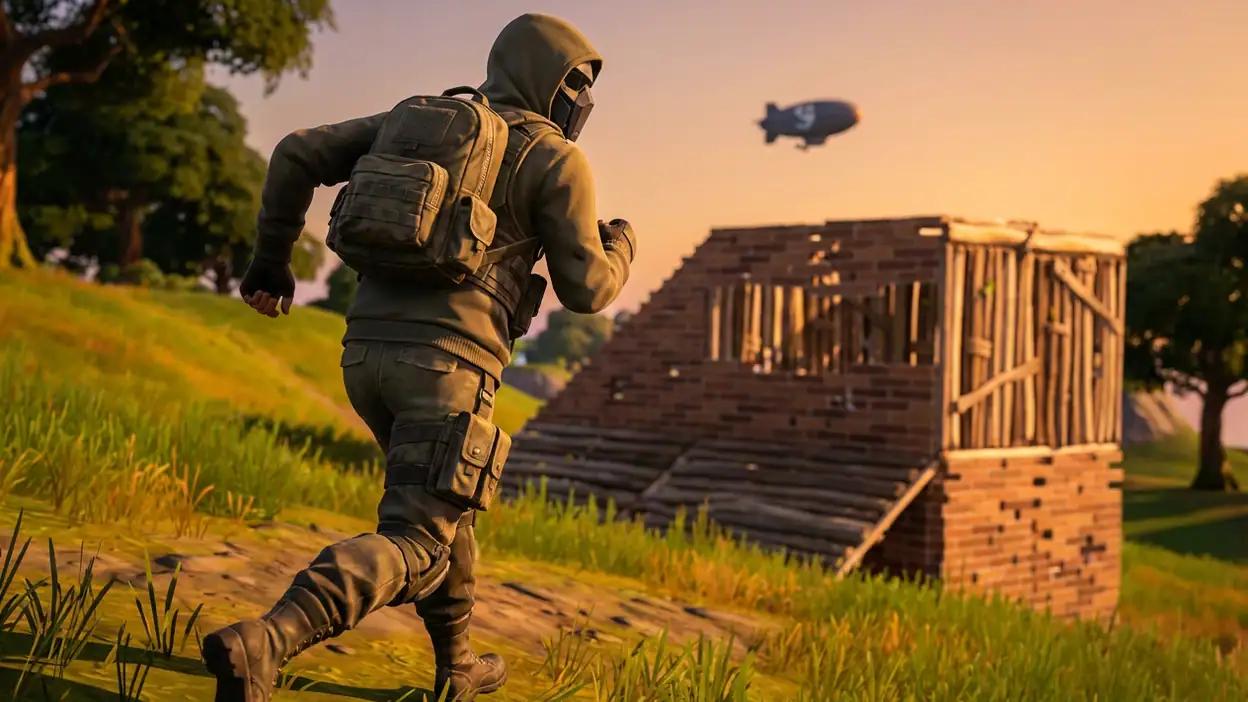
The first impression is visual, but not simply because the game is colorful. Fortnite has a readable visual language. Characters, buildings, weapons, vehicles, and terrain separate cleanly at a glance, which matters when the screen is smaller and your thumbs are already busy. The art direction gives the island personality without sacrificing the practical information needed to survive.
Then comes the sound. Footsteps, distant gunfire, a chest behind a wall, and the changing pressure of the storm all help you understand the match before you fully see it. Good audio design turns a phone into a surprisingly tense little window. Playing with headphones makes the difference especially clear: you begin to hear danger as a direction, not just as noise.
The controls take longer to appreciate. A touchscreen cannot reproduce the effortless precision of a controller, and Fortnite does not pretend otherwise. The layout is busy at first, with movement, aiming, building or utility actions, inventory management, and contextual buttons competing for space. Yet the system becomes workable once you adjust the arrangement and spend time in less stressful modes. The important point is that the game gives you room to make the interface yours.
That flexibility matters more than a perfectly clean first minute. I would not call the mobile controls instantly elegant, but I would call them adaptable. Players who tune sensitivity, button placement, and assisted options can build a setup that feels personal. The game rewards that investment, especially in close fights where a small improvement in camera control can change the result.
The best ways to use it
The obvious use case is the quick solo match. You can enter, make a few decisions, and leave with a complete arc, whether that arc ends in victory or an embarrassing encounter with an opponent hiding behind a tree. Solo play is also the best way to learn the island because it gives you time to notice routes, landmarks, loot patterns, and the sound cues that reveal nearby players.
Squads are where Fortnite becomes more expressive. A good team match is not just four people shooting at the same targets. It is a conversation conducted through movement: one player marks a route, another carries useful supplies, someone takes the high ground, and a fourth person makes an impulsive push that everyone else has to rescue. Voice chat can make these sessions lively, but the game remains playable through quick pings and simple signals when nobody wants to speak.
Creative experiences provide a different kind of value. They turn Fortnite from a match-based shooter into a catalogue of player-made spaces, challenges, races, and experiments. Quality varies, naturally, but that variety is part of the appeal. You can move from a conventional firefight to a strange obstacle course or a compact social space without installing a separate game. For mobile players, that breadth makes the app feel unusually substantial.
There is also a strong case for using Fortnite as a casual social room. You do not always need to chase a win. Exploring, trying a new mode, watching friends make questionable decisions, or testing a new item can be enough. The game has learned that not every session needs to justify itself through a scoreboard.
What feels fresh
Fortnite stays fresh through controlled instability. Its island, rules, items, and themed events change often enough to disturb routine, but the underlying language remains familiar. You still understand the basic goal when you return, yet you cannot rely entirely on last season's habits. That balance is difficult to maintain. Too much change alienates regulars; too little turns a live game into a museum piece.
The strongest updates are the ones that alter decisions rather than merely decorate the map. A new mobility item can change how players rotate. A different weapon can make close-range encounters more aggressive. A new location can create a fresh early-game pattern. These changes are felt in the hands, not just noticed in a menu. They keep experienced players curious without making newcomers learn an entirely different game every few weeks.
Fortnite's cultural reach also feeds that sense of movement. Crossovers and limited-time events can be noisy, but they give the game a public energy that few mobile titles can match. More importantly, they make the island feel connected to a wider entertainment conversation. The best collaborations do not replace the game; they give players another reason to return and share the experience.
What I appreciate most is the way Fortnite can be playful without becoming weightless. Its characters and objects often have a comic edge, but the moment-to-moment decisions still carry tension. You can laugh at a ridiculous outfit and then spend thirty seconds listening for footsteps in a cramped building. That tonal flexibility is one of the game's most durable design achievements.
Who will connect with it fastest
Fortnite will click fastest with players who enjoy games that leave room for personal style. If you like making quick plans, changing them under pressure, and learning from messy outcomes, the island gives you plenty to work with. You do not have to be the best shot in the lobby. Awareness, positioning, timing, and the willingness to retreat can carry you surprisingly far.
It is also a natural fit for groups of friends who want a shared game with more personality than a straightforward competitive shooter. Fortnite supports focused play, but it does not demand a grim mood. A squad can take the match seriously for five minutes and then spend the next five attempting something foolish. That social elasticity makes it easier to keep playing across different skill levels.
Creative-minded players may connect with it for a different reason. The attraction is not only winning but seeing what other people have built and finding unusual ways to use the game's tools. Fortnite can be a shooter, a playground, a party game, or a place to experiment. That range gives it a broader audience than its battle royale reputation suggests.
Newcomers should expect a learning curve, particularly if they meet experienced players early. The game has years of accumulated systems, and the island can feel overwhelming until its visual language settles into place. Still, the basic loop is easy to understand, and the early frustration is softened by the sheer number of ways to play.
Where it beats bigger names
Fortnite's advantage over larger, more established mobile services is not convenience. WhatsApp Messenger is better for direct communication, YouTube is better for passive viewing, and Google Play services quietly handles infrastructure that most people never think about. Fortnite wins on a different dimension: it turns time with friends into an active event.
That distinction matters. A chat can keep people connected, and a video can give everyone something to watch, but Fortnite asks players to create a shared memory through decisions. The funniest moment may come from a failed plan. The most satisfying moment may be a rescue that nobody expected. The app produces stories rather than simply carrying messages or serving content.
It also beats many mobile competitors through density. One download contains a polished battle royale, social spaces, player-created experiences, regular events, and a deep progression layer. Not every part will appeal to every player, but the package is unusually broad. You can stay within the familiar mode or keep moving until you find a version of Fortnite that suits your mood.
Another advantage is its willingness to let spectacle and mechanics coexist. Some games use visual excitement to cover thin interaction. Fortnite usually gives its spectacle a practical role. A collapsing structure changes cover. A vehicle changes distance. A storm changes priorities. The world is not just scenery; it is part of the argument you make during a match.
Where it still has limits
The mobile version asks a lot from the device. Storage requirements can be substantial, downloads may be large, and performance depends heavily on the phone or tablet you use. On capable hardware, the game can look remarkably close to its larger-platform identity. On weaker devices, visual compromises, heat, battery drain, and uneven frame rates can become impossible to ignore.
Touch controls remain the other major obstacle. A skilled player can build an effective layout, but the screen is still a less comfortable battlefield than a controller or keyboard and mouse. Long sessions can feel physically tiring, especially when you are constantly adjusting your aim and camera. Fortnite is playable on mobile; that does not mean it is effortless on every phone.
The game can also feel crowded. There are quests, currencies, cosmetics, modes, events, passes, and rotating activities competing for attention. That abundance is part of the appeal, but it can obscure the simple pleasure of landing, finding a weapon, and surviving. New players may need to ignore a great deal of presentation before they understand what deserves their time.
Finally, the live-service structure can create pressure to keep up. Limited events and changing rewards encourage regular visits, which is useful for the community but less comfortable for players who prefer a finished, self-contained experience. Fortnite is at its best when you treat its updates as invitations rather than obligations.
Why now is the right moment
Fortnite is worth returning to now because it has matured without becoming static. The game has enough history to feel confident, yet its changing island and rotating experiences keep it from settling into a predictable routine. For a new player, that means there is a large community, a deep library of content, and plenty of current activity to discover. For a former player, it means the familiar parts are still recognizable while the details have moved on.
There is also a practical reason to try it now: mobile hardware is better suited to ambitious games than it was when the mobile battle royale wave first exploded. Faster phones, stronger displays, improved controllers, and more reliable connections make the experience easier to recommend, provided your device meets the demands. The game still benefits from a stable connection and a reasonable amount of free storage, but the technical gap between mobile and other platforms is less intimidating than it once was.
Most of all, Fortnite remains a rare game that can be approached at several depths. You can play for ten minutes without understanding every system, or spend months refining movement, aim, rotations, and team strategy. You can chase wins, explore creative maps, or simply join friends for a noisy evening. That range is the reason it continues to feel relevant rather than merely famous.
The best mobile games give you a reason to return without making you feel trapped. Fortnite achieves that through variety, social energy, and a match loop that keeps producing small surprises. It is demanding, sometimes cluttered, and not especially gentle on older hardware. But its strengths are concrete: readable action, expressive teamwork, meaningful improvisation, and a world that keeps changing around a stable core.
My editor's note is simple: install Fortnite if you want a mobile game that can become whatever kind of session you need. Approach it as a competitive shooter and it has depth. Treat it as a social playground and it has warmth. Use it as a quick escape and it still knows how to make ten minutes feel like a story. That combination earns the recommendation now, not because Fortnite is merely still popular, but because it remains unusually good at making mobile play feel like an occasion.